23 Jul 2026
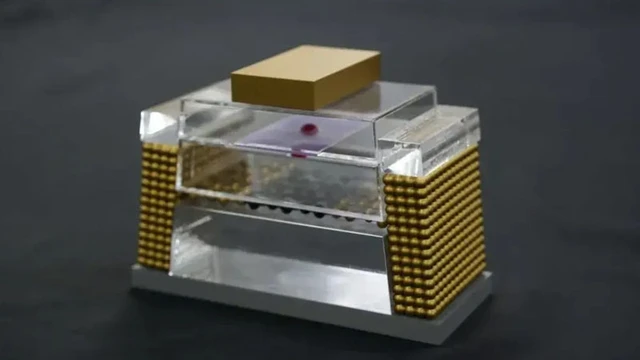 The Information Density Limit of a Single Electron
The modern data storage industry is rapidly approaching its physical ceiling, where traditional recording methodologies are becoming prohibitively energy-intensive and cumbersome. In an era defined by the explosive growth of neural networks, the requirement for ultra-dense memory—positioned in immediate proximity to compute cores—has become critical. Researchers at Fudan University have proposed a paradigm shift, moving data storage down to the level of fundamental particles. By utilizing a single electron to represent a bit of data, this innovation opens the door to devices characterized by unprecedented density and extreme energy efficiency.
22 Jul 2026
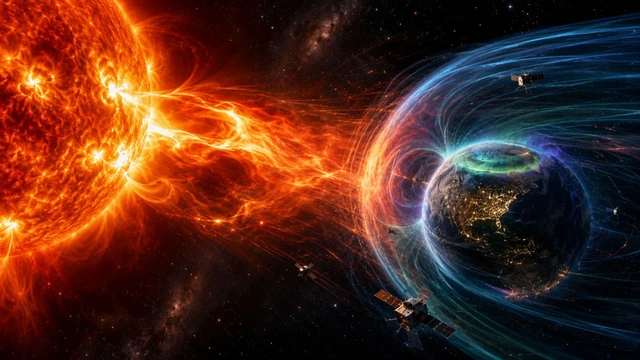 Reevaluating the Risks of Geomagnetic Catastrophes
Space weather has long been the ultimate wildcard—a variable humanity has strove to quantify with absolute precision. For decades, the prevailing consensus was that Earth’s magnetosphere functioned as a natural buffer, mitigating the impact of the most violent solar flares. Yet, emerging research reveals a sobering truth: the so-called "saturation effect," long thought to shield the planet from catastrophic current surges, was nothing more than a statistical illusion. This revelation fundamentally reshapes our understanding of just how vulnerable we truly are in the face of extreme geomagnetic events.
22 Jul 2026
 Diamond-Based Quantum Computing
For years, the pursuit of scalable quantum computing has been bottlenecked by the necessity of extreme cryogenic cooling and ultra-high vacuum environments. While industry titans continue to rely on cumbersome cryogenic infrastructure, German startup Saxon Q is charting a radically different course. By leveraging synthetic diamonds, they are achieving quantum coherence at room temperature—a breakthrough that effectively transforms the quantum supercomputer into a standard server rack. This transition from experimental laboratory setups to viable commercial products promises to fundamentally democratize access to quantum processing power for both enterprise and academia.
21 Jul 2026
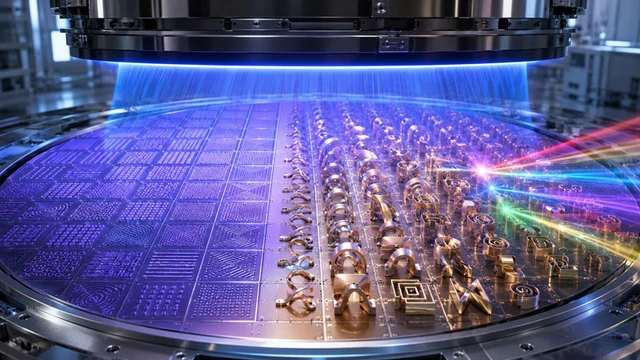 Scaling the Production of Three-Dimensional Photonics
The transition from conventional electronics to photonic computing demands a fundamental overhaul of fabrication methodologies—a paradigm where extreme precision must coexist with industrial-scale throughput. For years, ion-beam lithography has been hampered by its inherently sequential nature, rendering the creation of nanostructures a painstakingly slow endeavor. A novel approach to component patterning is now breaking this bottleneck, slashing wafer processing times from several hours to a matter of seconds. This breakthrough paves the way for the mass production of intricate 3D photonic circuits that were previously confined to the controlled environments of research laboratories.
21 Jul 2026
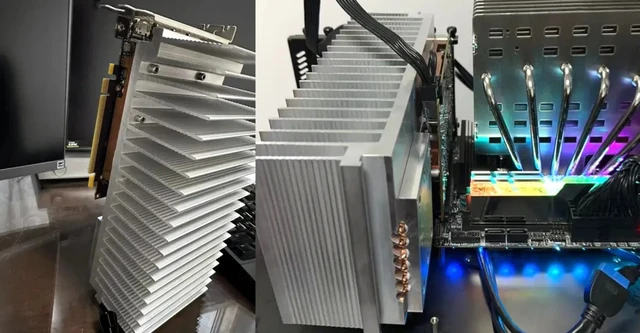 GeForce RTX 4060: The Threshold of Silence
The pursuit of absolute silence in PC hardware often necessitates radical engineering interventions. In an era dominated by active cooling, the notion of a fully passive system feels almost utopian when applied to high-performance GPUs. Yet, the advent of highly energy-efficient silicon is unlocking new possibilities for thermal management experimentation. The modification of the GeForce RTX 4060 serves as a compelling case study, proving that with sufficient thermal mass, even demanding workloads can be tamed without a single spinning fan.
21 Jul 2026
 The Paradox of Supermassive Black Hole Growth
For years, one of the most enduring enigmas of the early universe has been the existence of gargantuan objects that seemingly defied the constraints of cosmic time—structures far too massive to have grown to such scales within the available window. Supermassive black holes, with masses billions of times that of our Sun, appeared in the cosmos far earlier than traditional evolutionary models predicted. The primary obstacle to their growth was long thought to be a "self-starvation" paradox, where intense energy emissions would repel the very matter needed for accretion. However, recent data from the James Webb Space Telescope are prompting a fundamental reassessment of this process, revealing a hidden mechanism of cosmic recirculation.
17 Jul 2026
 Next-Generation Spin System Synchronization
Modern microelectronics is steadily approaching the physical limits of silicon technology, where thermal dissipation and power consumption have become the primary bottlenecks to progress. This search for a viable alternative has led researchers toward spintronics—a field where information is transmitted not through the movement of electrical charges, but via the intrinsic spin of electrons. The recent success in synchronizing an array of over 100,000 nano-oscillators demonstrates the technical feasibility of this approach, paving the way for a fundamentally new generation of computing architectures.
17 Jul 2026
 The Atmosphere of Rocky Planet LHS 1140 b
The search for extraterrestrial life is shifting from the realm of theoretical hypothesis into the domain of rigorous empirical data. For decades, astronomers have pursued an "Earth twin"—a rocky world with a dense atmosphere orbiting within its star's habitable zone. The discovery of LHS 1140 b marks a watershed moment in this quest for knowledge; science now possesses its first compelling evidence that terrestrial conditions can indeed exist beyond the confines of our own solar system.
16 Jul 2026
 The Risks of Extreme Cooling in Mobile Electronics
Abnormal heatwaves have emerged as a systemic global challenge, threatening not only ecological stability but the operational integrity of modern electronics. In a desperate attempt to combat overheating, users frequently resort to intuitive—yet perilous—cooling hacks. Viral trends across social media platforms often promote misguided techniques, such as placing devices in refrigerators for rapid thermal reduction. Such an approach defies fundamental laws of physics and inevitably leads to catastrophic hardware failure.
14 Jul 2026
 Programmable Thermal Radiation Control
For too long, thermodynamics has been perceived as a domain of immutable constraints and irreversible processes. The traditional principle of reciprocity governed the paradigm: heat absorption and emission were viewed as symmetric counterparts, severely limiting the potential for precision energy management. However, a pioneering breakthrough by Japanese researchers is fundamentally shifting our approach to managing heat flux. The development of materials with programmable emissivity paves the way for a new generation of devices where thermal energy becomes as flexible and controllable a resource as electrical current is in modern electronics.
13 Jul 2026
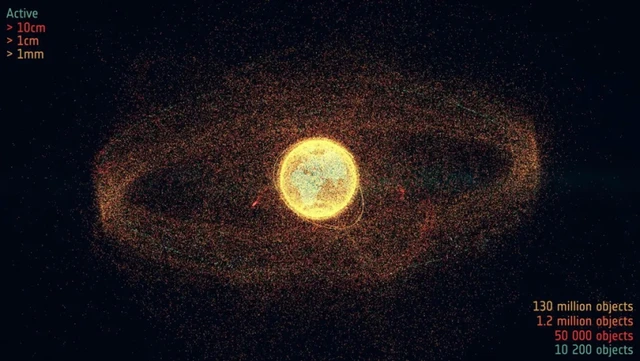 The Risks of Orbital Contamination in the Geostationary Belt
Earth’s orbital environment is steadily evolving into a high-risk zone. Of particular concern is the geostationary orbit (GEO), where the world's most expensive and strategically critical communication and surveillance satellites are concentrated. Recent research has revealed the presence of small, previously undetected fragments that effectively create a "minefield" at an altitude of 36,000 kilometers. In the absence of atmospheric drag to clear these orbits, this debris poses a permanent threat to our global digital infrastructure.
13 Jul 2026
 Next-Generation Hybrid Solar Power
The global energy transition is confronting a systemic hurdle: the inherent intermittency of renewables and their dependence on diurnal cycles. The solution lies in the strategic synergy of diverse solar harvesting technologies, enabling energy accumulation without relying on cost-prohibitive chemical storage. A landmark project recently launched in Xinjiang is redefining the paradigm of utility-scale power generation; the facility serves as a proof-of-concept for how the hybridization of photovoltaics (PV) and Concentrated Solar Power (CSP) can maintain grid stability long after the sun has set.
