The vision of a global quantum internet hinges on the ability to transmit entangled particles across vast distances. However, the inherent fragility of quantum states renders them hypersensitive to external interference, effectively turning conventional fiber-optic networks into hostile environments. Recent breakthroughs in physics suggest that the divide between the sterile confines of the laboratory and the chaos of urban infrastructure is finally closing. A successful demonstration of entanglement transmission over existing communication lines proves that our current network architecture is capable of serving as the foundation for a quantum revolution.
The bedrock of the future quantum internet lies in the transmission of entangled photons—particles whose quantum characteristics remain inextricably linked regardless of the distance separating them. This correlation enables the creation of absolutely secure data channels and the integration of remote quantum processors into a single, distributed computing network. In practice, however, quantum entanglement is notoriously fragile: any external interference can trigger decoherence. While this process is manageable within the controlled environment of a laboratory, it becomes the primary obstacle when deployed across real-world urban networks.
A recent collaboration between the National Institute of Standards and Technology (NIST) and the University of Maryland marks a pivotal milestone in overcoming this barrier. Researchers successfully transmitted entangled photons over a distance of 62 km using standard overhead communication lines. A critical aspect of the experiment was that approximately 70% of the route consisted of aerial cables. Unlike shielded underground conduits, these lines are exposed to wind, temperature fluctuations, and vibrations from urban traffic.
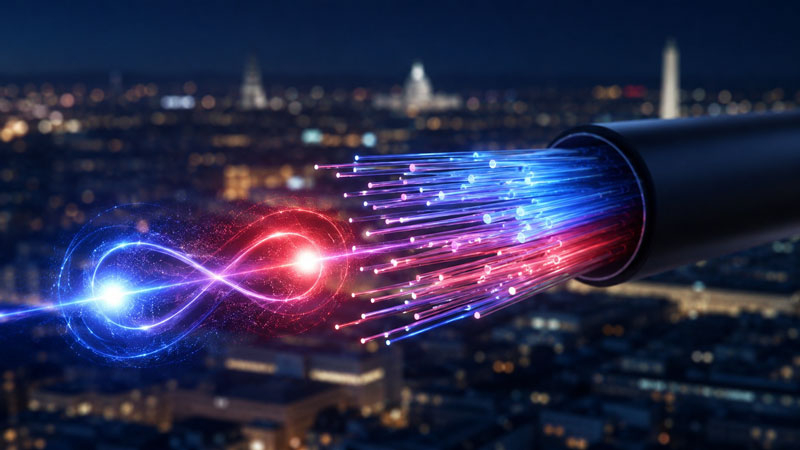
Such external factors induce birefringence within the optical fiber, leading to spontaneous shifts in the polarization of the passing light. For quantum states, where information is encoded specifically via polarization, these fluctuations are catastrophic. Nevertheless, the experiment confirmed that even within unstable infrastructure, polarization entanglement can be maintained long enough to support full network functionality.
The technical implementation relied on the generation of photon pairs in the Bell state $\Phi^+$, where horizontal and vertical polarizations are strictly correlated. One photon from each pair remained at the NIST laboratory as a signal reference, while the second was dispatched across the 62-kilometer fiber. Total signal loss was approximately 21 dB, accounting for attenuation within the line itself as well as losses at connectors and auxiliary equipment. To register the particles, the team employed superconducting nanowire single-photon detectors (SNSPDs) with an efficiency exceeding 70%. Consequently, from an initial stream of 200,000 pairs per second, approximately 1,500 coincident pairs were recorded at the receiving end.
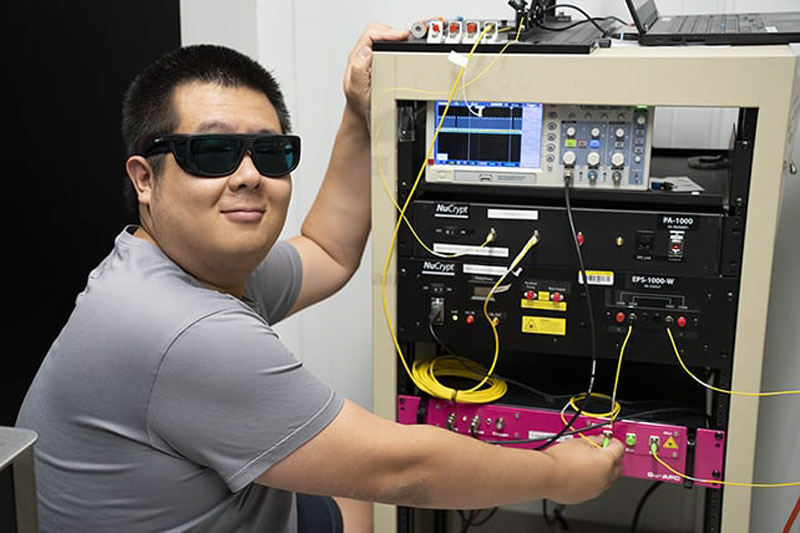
The key technological breakthrough was a system for continuous polarization compensation. To stabilize the channel, a reference laser signal with a power of 0.5 mW at a wavelength of 1549.32 nm was periodically pulsed through the line. The system analyzed the shifts in these reference polarization states and restored them using a specialized algorithm. If the fidelity of the reference states dropped below 98%, a correction cycle was automatically triggered until a 99% threshold was reached. Crucially, the quantum transmission and the calibration laser operated alternately to ensure that the intense light of the reference signal did not "blind" the hypersensitive single-photon detectors.
The results of the 24-hour trial were impressive: the system spent only 7.2% of its time on polarization correction, leaving nearly 93% of the window available for quantum data transmission. Without active stabilization, transmission quality degraded rapidly, making it impossible to recover the entangled state. This proves that even low-grade cabling infrastructure can be viable for quantum communications, provided effective correction mechanisms are in place. Although data rates remain low for now, the successful navigation of a "noisy" environment paves the way for the deployment of practical quantum networks leveraging existing communication infrastructure.

 Next-Generation Ultra-Lightweight Lens Technology