Quantum computing has long been hampered by the inherent fragility of quantum states and pervasive noise. The primary barrier to practical implementation has been the staggering amount of overhead required for error correction. As D-Wave pivots from specialized quantum annealing toward universal quantum computing, the company has introduced a solution designed to drastically reduce these overheads. Their novel approach enables the system to identify faults autonomously and in real-time, paving the way for the development of truly scalable and stable quantum architectures.
For years, D-Wave has been synonymous with quantum annealing—a method highly effective for niche optimization tasks. However, the industry is pivoting toward universal quantum computers capable of executing any algorithm, unlocking virtually limitless potential. In this context, D-Wave’s transition into the universal computing segment marks a watershed moment, particularly given their novel approach to tackling one of the industry's most persistent hurdles: decoherence and computational errors.
The fundamental challenge facing modern quantum processors is the extreme sensitivity of qubits to external interference. Any environmental perturbation can distort a quantum state, and frequently, the system is unable to pinpoint exactly where the failure occurred. The traditional remedy involves implementing complex overheads and error-correction algorithms, which demand an immense amount of additional resources.
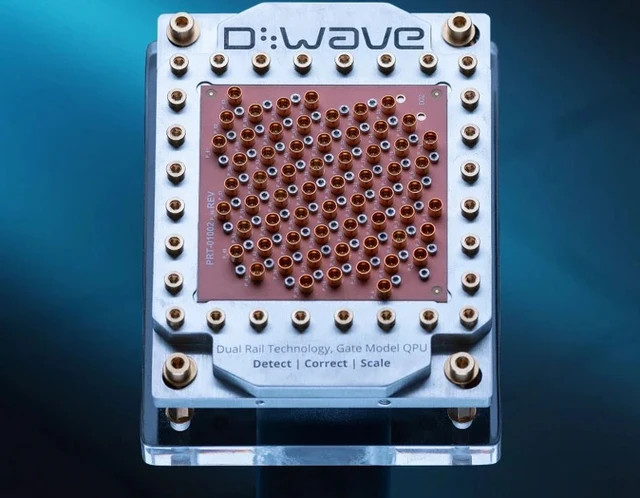
D-Wave’s engineers have proposed a paradigm shift based on so-called "dual-rail qubits." In this architecture, the quantum state is distributed across a pair of coupled resonators. Due to the physical principles of this implementation, errors become "visible" to the system the moment they occur. This means the processor doesn't simply produce an incorrect result; it receives a definitive signal identifying exactly which qubit failed.
Translating this theory into practice, however, presented a significant challenge: qubit interaction. During joint operations and the creation of quantum entanglement, the system's ability to detect its own errors typically plummets. In a recent paper published in Nature, researchers demonstrated a two-qubit quantum gate that successfully overcomes this obstacle, enabling qubits to interact while preserving the built-in error-detection mechanism.
The experimental metrics are promising: the fidelity of two-qubit operations reached approximately 99.9%, with an operation duration of 500 nanoseconds. Yet, the long-term implications are far more significant. Calculations suggest that this scheme can reduce logical error rates by roughly tenfold with each successive level of error-correction coding.
In quantum computing, there is a critical distinction between a physical qubit (the actual hardware component) and a logical qubit (an idealized unit of information protected from errors). Typically, creating a single stable logical qubit requires hundreds or even thousands of physical ones. D-Wave’s approach significantly reduces this ratio. By knowing exactly where an error occurred, the requirements for auxiliary hardware and physical qubit redundancy are drastically lowered.
Admittedly, this demonstration on a two-qubit system is merely the first step. The road to a fully realized, commercially viable fault-tolerant computer remains long. Nevertheless, this proof-of-concept for dual-rail systems provides the industry with a powerful scaling tool, transforming the battle against noise from an endless race into a manageable engineering process.
 The Price of Acceleration: CXMT’s Rapid Push into Memory