For decades, the quest for optimal solar energy harvesting has centered on sophisticated tracking systems and high-precision panel alignment. Yet, sensitivity to the angle of incidence remains a critical bottleneck for fixed-tilt installations, particularly where spatial constraints are tight. Researchers at Qatar University have proposed a paradigm shift: moving from planar surfaces to spherical geometries capable of capturing sunlight from virtually any angle. This approach prompts a fundamental reconsideration of photovoltaic architecture, allowing us to quantify the actual trade-offs involved in eliminating mechanical solar tracking.
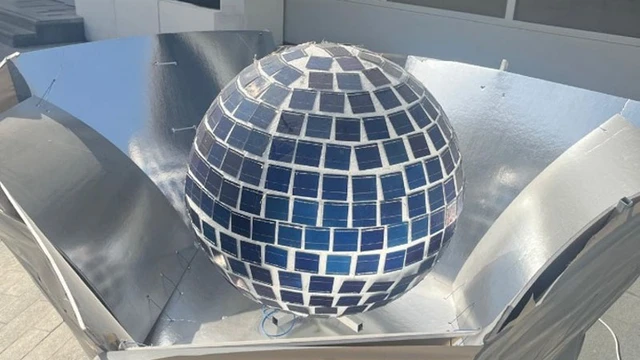
At its core, the concept seeks to eliminate the primary pain point of traditional solar energy: the need for constant panel positioning relative to the sun. While standard systems rely on costly servos and sensors to track the solar arc, Qatari researchers have turned to geometry. They have developed a spherical photovoltaic module with a diameter of 0.7 meters, designed essentially as an omnidirectional energy receiver.
Architecturally, the device is a sophisticated assembly: 450 single-sided silicon cells, each measuring 52 × 52 mm, are mounted onto an opaque expanded polystyrene base. These cells are connected in series and cover approximately 80% of the sphere's surface. The remaining area is reserved for wiring and electrical interconnects, creating a cohesive energy system that requires no external rotation to optimize photon capture.
The pivotal technological breakthrough is an auxiliary hemispherical reflector made of polished aluminum, positioned at the base of the installation. From a physics perspective, this element functions as a passive concentrator with an albedo coefficient of 0.95. The reflector redirects rays that would otherwise bypass the system or hit the sphere's "blind zone," bouncing them back onto the module's lower hemisphere. According to simulation results, this configuration increases total energy yield by approximately 71% compared to a simple sphere without a reflector, while maintaining a ground footprint of just 1.74 m².
Field trials were conducted in Doha over a nine-day period. The system was monitored via an automated complex based on an ESP32 microcontroller, which recorded current, voltage, surface temperature, and ambient climatic parameters in real time. During this window, the installation generated 183.17 Wh. A notable observation was the system's resilience to soiling: after nine days of operation without cleaning, power output decreased by only 8%. This suggests that the spherical geometry offers inherent advantages in self-cleaning or reduces dust accumulation compared to traditional flat surfaces.
However, detailed analysis reveals that geometric elegance does not always translate into economic efficiency. A comparative study against a standard flat panel—south-facing with a 25° tilt—yielded mixed results. During the summer months (June–August), the spherical module indeed holds an edge, outperforming the flat panel in energy production by roughly 7.3%. Yet, on an annualized basis, the tide turns: the sphere generates 405.5 kWh compared to 425.0 kWh from the optimized flat installation. Consequently, the advantage of the omnidirectional approach manifests for only four months out of twelve.
The Levelized Cost of Energy (LCOE) was similarly less attractive. The cost per kilowatt-hour for the spherical system stood at $0.0424, compared to $0.0320 for the traditional panel—representing a cost increase of approximately 32.5%.
Despite these figures, the work of the Qatari researchers remains highly valuable as a proof of concept. The spherical module opens new avenues for solar application where conventional installations are impractical: in dense urban environments with variable shading, in polar latitudes with low solar angles, or at remote sites where panel maintenance and cleaning are challenging. It is a significant step toward creating autonomous energy nodes that operate efficiently regardless of their orientation.
 Next-Generation Ultra-Lightweight Lens Technology