The transition of quantum computing from sterile laboratories to industrial data centers necessitates a fundamental paradigm shift in cooling engineering. Conventional cryostats—cumbersome, standalone units—have emerged as the primary bottleneck in scaling systems based on superconducting qubits. IBM is addressing this challenge by developing standardized cryogenic modules designed for seamless integration into a unified network. This evolution transforms the quantum computer from a bespoke, singular curiosity into a scalable piece of industrial infrastructure.
The primary challenge in working with superconducting qubits is their extreme susceptibility to thermal noise. Even the slightest thermal fluctuation can collapse a fragile quantum state, leading to increased error rates and decoherence. To mitigate this, processors must operate at temperatures approaching absolute zero. Until now, this has been achieved using cylindrical cryostats—essentially hermetically sealed "bunkers" equipped with multi-layered cooling systems—which are notoriously difficult to interconnect.
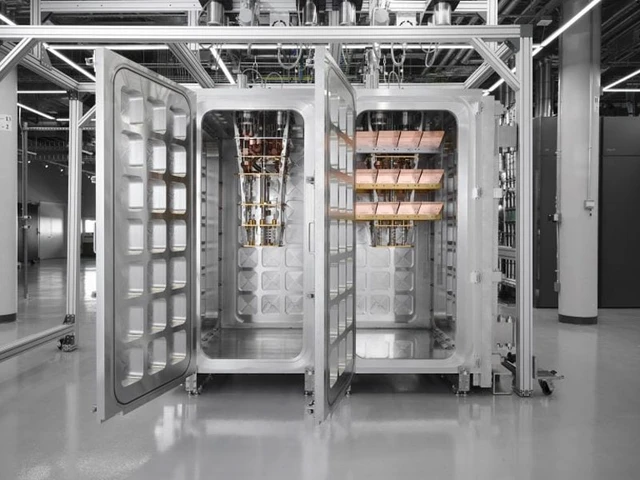
IBM has reimagined this approach, replacing traditional cylinders with rectangular cryogenic cells. This geometry allows modules to be positioned flush against one another, creating a unified ultracold environment. Each cell functions as an autonomous vacuum chamber with its own cooling system and a cascade of thermal shields. When modules are docked, these shields form a shielded cryogenic tunnel, serving as a secure conduit for communication lines between adjacent quantum processors.
The technical breakthrough here lies not only in the form factor but in resource density. A single vacuum chamber provides approximately 2.75 m³ of volume, representing a twelve-fold increase in wiring capacity compared to previous system iterations. This is critical, as the number of interconnections between processor units scales exponentially as the qubit count increases.
To facilitate interaction between distributed processors, specialized L-couplers were developed. These microwave lines, operating at cryogenic temperatures, enable chips to communicate across distances of up to one meter. Thanks to the compact rectangular layout, signal attenuation and interference are minimized, while thermal leakage between adjacent modules remains negligible. Consequently, expanding the system with additional cells does not lead to a critical increase in cooldown time or destabilize the thermal regime.
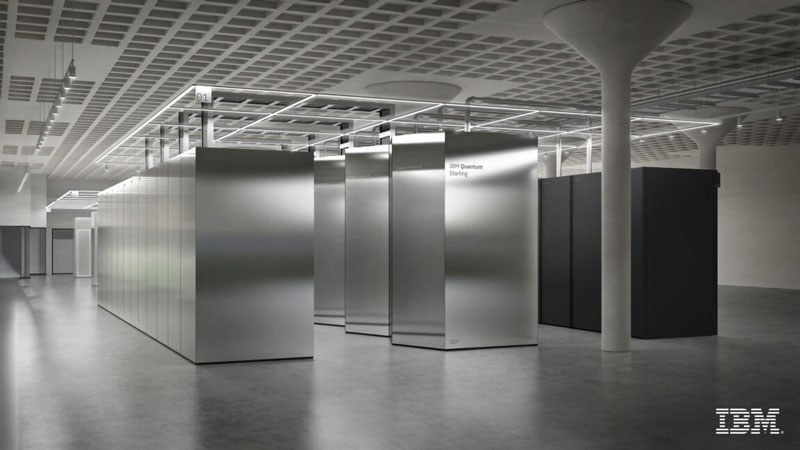
This engineering strategy serves as the foundation for a long-term roadmap toward fault-tolerant quantum systems. In the coming years, the company intends to scale capacity incrementally: by 2026, Nighthawk processors will be integrated into these modules, and by 2027, the goal is to unite several such blocks into a single computer boasting over 1,000 programmable qubits.
The culmination of the current development phase will be the Starling system, scheduled for launch in 2029. The objective is ambitious: to create a machine with 200 logical qubits protected by quantum error correction, capable of executing up to 100 million operations. By solving the physical placement and cooling challenges for processors within standard data center environments, IBM is effectively removing one of the primary infrastructure bottlenecks on the path to a full-scale quantum supercomputer.
 The Price of Acceleration: CXMT’s Rapid Push into Memory