Optical fibers have long since evolved beyond their role as mere data conduits, transforming into sophisticated instruments for structural health monitoring. However, the conventional cylindrical geometry of silica glass imposes inherent constraints on the sensitivity of such systems. The breakthrough lies in the transition to a planar architecture, which fundamentally alters the physics governing the interaction between light and mechanical strain. This innovation increases measurement precision a thousandfold, effectively engineering an artificial nervous system for industrial infrastructure.
The use of optical fiber as a sensing mechanism is a well-established practice. The physics of light propagation within a fiber allows for the detection of minute environmental fluctuations, making such systems indispensable for monitoring seismic activity. However, until now, the industry has relied on standard round fibers, whose capabilities are fundamentally limited by the geometry of the quartz rod.
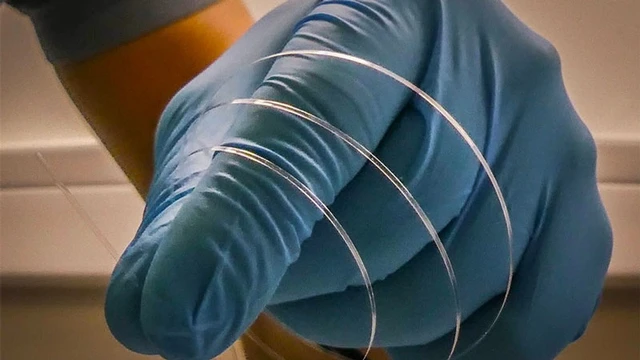
A significant leap forward has arrived with the introduction of the HARFF (High Aspect-Ratio Flat Fiber) platform. The core of this innovation lies in a radical redesign of the waveguide: replacing the conventional cylinder with a flat, ribbon-like cross-section characterized by a high width-to-thickness ratio. In experimental prototypes, this ratio has reached 20:1. This geometry fundamentally alters the glass's mechanical response to transverse loads, increasing the sensitivity of pressure sensors by three orders of magnitude compared to traditional counterparts.
The technical implementation of HARFF involves the creation of a sophisticated internal architecture. The flat fiber can incorporate air microchannels, multiple parallel waveguides, or specialized inserts made from alternative materials, transforming a simple quartz element into a multifunctional tool. For instance, to create an ultra-precise thermometer, one of the channels is filled with a tin-based alloy with a melting point of approximately 220°C. As it heats, the metal expands, inducing mechanical stress within the glass that alters the refractive index of light. These shifts are easily detected using standard telecommunications equipment.
The precision of pressure measurement is particularly noteworthy. In samples measuring 80 $\mu$m in thickness and 655 $\mu$m in width with two internal air channels, sensor resolution has reached the level of single-digit kilopascals. A critical advantage of this technology is its compatibility: flat fibers can be seamlessly fused with conventional round cables. This means that deploying these hypersensitive sensors does not require replacing expensive base infrastructure or procuring new hardware.
The potential applications for these "glass nerves" are vast. Due to their form factor and high sensitivity, flat fibers can be integrated directly into the structure of composite materials. This paves the way for "smart" aircraft, drones, and bridges capable of reporting micro-cracks or material fatigue in real time.
In the energy sector, this technology could become critical for battery system safety. Embedding sensors directly into batteries would allow for the high-fidelity monitoring of electrode expansion, gas evolution, and dangerous temperature spikes, preventing failures at their earliest stages. Beyond industrial use, such monitoring capabilities open new horizons in medicine, where the non-invasive and precise tracking of physiological parameters within living tissue is paramount.
 Next-Generation Ultra-Lightweight Lens Technology