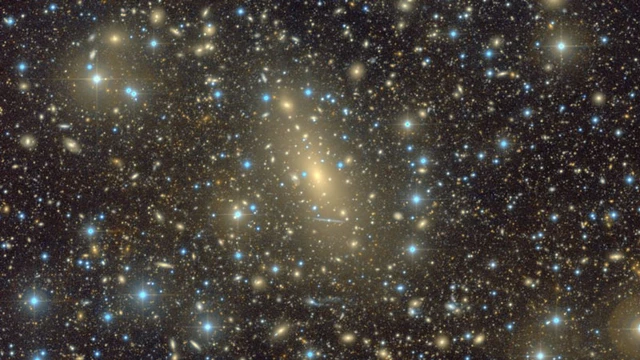
The early universe continues to defy conventional astrophysical paradigms. The James Webb Space Telescope has identified objects that blur the traditional boundaries between stars and black holes. The discovery of MoM-BH*-1 points toward a new class of celestial bodies—"black stars"—which harbor gravitational behemoths at their core. This phenomenon may provide the key to understanding how supermassive black holes attained such colossal proportions in the immediate aftermath of the Big Bang.
Deep in the cosmic void, approximately 660 million years after the Big Bang, an object designated MoM-BH*-1 has been identified. Its discovery was made possible by the James Webb Space Telescope's infrared capabilities, confirming a significant redshift of $z=7.7569$. Visually, the object resembles the so-called "little red dots"—mysterious radiation sources that have recently been detected in abundance. However, a detailed spectral analysis revealed a paradox: while the object exhibits the characteristics of a star, it emits energy levels physically impossible for any stellar body.
The primary anomaly of MoM-BH*-1 lies in its luminosity, which exceeds the capacity of the brightest star in the universe by a factor of 100 billion. In classical stellar evolution, such power would require a level of thermonuclear fusion that simply cannot be sustained within a single core. The only logical source for such colossal energy is the process of matter accretion onto a supermassive black hole.
Nevertheless, spectral analysis reveals a pronounced Balmer break—a signature characteristic of dense stellar atmospheres. This rules out the possibility that we are observing a typical nebula or a diffuse gas-and-dust cloud surrounding a black hole. The object possesses a gas envelope so dense that it effectively mimics a stellar photosphere, creating the illusion of a conventional star. Furthermore, the envelope consists solely of hydrogen and helium, indicating the primordial nature of the matter, uncontaminated by the heavy elements produced by subsequent generations of stars.
Physical modeling of the processes within MoM-BH*-1 suggests that the accreting black hole is encased in a nearly spherical envelope of ultra-dense hydrogen. The gas density within this structure reaches $10^{11}$ cm$^{-3}$, with turbulent flows moving at speeds of approximately 500 km/s. The scale of this system is staggering: its diameter ranges from 10 to 100 astronomical units, comparable to the dimensions of our own Solar System. It is this opaque gaseous veil that absorbs radiation and imparts the object's characteristic red hue, forming a sort of "cocoon" around the central gravitational engine.
Determining the precise mass of the central black hole is complicated by the extreme environment and multiple photon scattering, which distort the spectral lines. Under such conditions, traditional measurement methods may overestimate the mass by two orders of magnitude. Nonetheless, computational models suggest a range between $10^6$ and $10^7$ solar masses.
Such a "black star" configuration is of fundamental importance to cosmology. It elucidates the mechanism of ultra-rapid black hole growth, which occurs even faster than the theoretical Eddington limit. This provides an answer to one of the central questions of modern astrophysics: how black holes with masses of billions of solar masses managed to form in the early universe, less than a billion years after the dawn of time. MoM-BH*-1 likely serves as a prototype for the mechanism generating most "little red dots," opening a new chapter in our understanding of the evolution of matter during the epoch of galactic genesis.
 Next-Generation Ultra-Lightweight Lens Technology