20 Jul 2026
 Secure Remote Management Standard
In an era of pervasive digital surveillance, data privacy has emerged as the pivotal criterion for selecting enterprise software. For too long, the remote access market has been dominated by proprietary behemoths—closed-source incumbents that stifle customizability and obscure operational transparency. The rise of open alternatives is disrupting this paradigm, granting organizations total infrastructural sovereignty and guaranteed confidentiality. The latest release of HopToDesk (version 1.46.6) solidifies this trajectory, seamlessly blending the security of end-to-end encryption with comprehensive cross-platform flexibility.
20 Jul 2026
 The Evolution of Meeting Context within the Microsoft Ecosystem
The corporate landscape is pivoting rapidly toward a paradigm of intelligent productivity, where the drudgery of manual information retrieval is being supplanted by generative models. Microsoft continues its aggressive push to integrate AI into every facet of its ecosystem, fundamentally transforming familiar interaction tools. Yet, the transition from basic algorithms to sophisticated large language models inevitably necessitates a shift in access and pricing structures. The latest overhaul of Outlook’s functionality exemplifies this trend: core capabilities are increasingly yielding to premium, Copilot-powered services.
20 Jul 2026
 The Trap of Proprietary Office Software Standards
The global productivity software market has long been a battleground where the ethos of open access clashes with strategies of corporate hegemony. At the heart of this conflict stand The Document Foundation and Microsoft—two entities with fundamentally divergent philosophies regarding data sovereignty. This is not merely a question of file interoperability; it is about the fundamental right of the user to maintain absolute control over their own information. The friction surrounding proprietary formats exposes a systemic issue of vendor lock-in, creating a technological dependency that stifles the digital autonomy of millions of organizations worldwide.
20 Jul 2026
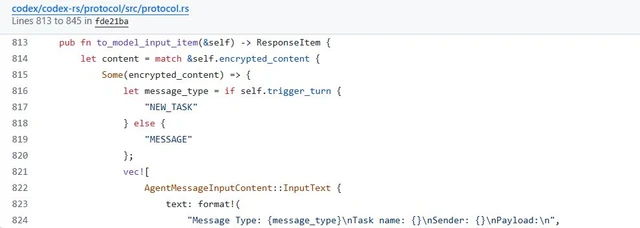 The Cryptographic Barrier within the Codex Ecosystem
The contemporary AI landscape is evolving beyond rudimentary chatbots toward sophisticated multi-agent architectures, where a primary orchestrator manages an ecosystem of specialized sub-agents. Within this paradigm, interaction transparency has emerged as a mission-critical requirement for both system debugging and robust security. Yet, in a surprising pivot toward opacity, OpenAI is implementing the encryption of internal instructions within Codex. This strategic move signals a new epoch in the protection of intellectual property and data privacy, specifically targeting the layer of inter-model communication.
20 Jul 2026
 Credit Risks in the Age of Generative AI
The global AI arms race is pivoting from a phase of unbridled optimism to one of rigorous financial scrutiny. S&P’s decision to downgrade Oracle’s credit rating serves as a watershed moment, laying bare the systemic risks inherent in tech giants tethering their fortunes to the ambitions of startups. The market is now confronting a sobering reality: massive infrastructure investments risk becoming a liability if the business models of AI consumers fail to prove viable. This establishes a precarious precedent, where the financial resilience of a corporate titan becomes contingent upon the solvency of some of the industry's most volatile players.
20 Jul 2026
 The End of the Jacobian Hypothesis Era
The mathematical community has encountered a development that could redefine the very nature of fundamental research. The Jacobian conjecture, which has remained unsolved since 1939, has been called into question by the immense computational power of modern artificial intelligence. Unlike traditional proofs, the objective here is the pursuit of a counterexample—a specific instance that renders the general assertion false. This precedent marks a pivotal transition for neural networks, elevating them from mere tools to full-fledged researchers.
19 Jul 2026
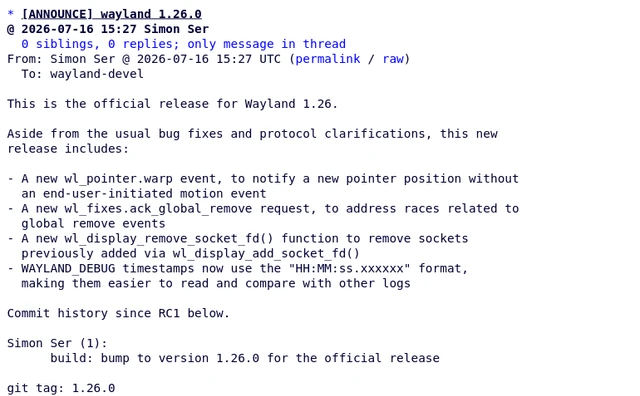 Wayland 1.26: New Horizons in Visual Interaction
The open-source community’s migration toward a modern display server standard continues apace, steadily phasing out the legacy architecture of X11. The release of Wayland 1.26 marks another milestone in the ecosystem's stabilization process, signaling a shift in focus from foundational functionality to the granular optimization of component interoperability. In this iteration, developers have prioritized the resolution of critical race conditions and the expansion of support for cutting-edge hardware management. The result is a tool engineered for absolute rendering precision and a frictionless user experience.
18 Jul 2026
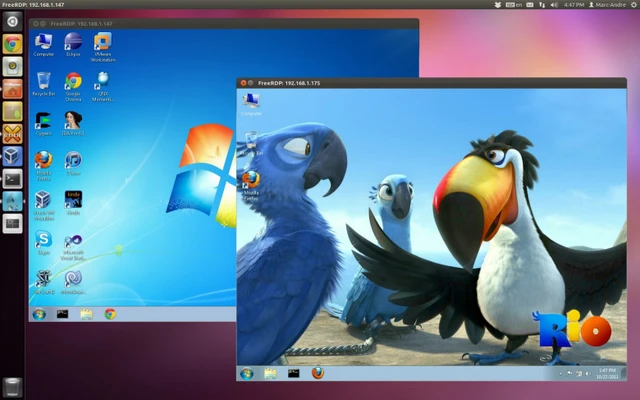 Security and Stability in FreeRDP 3.30
Remote desktop protocols remain a critical pillar of modern IT infrastructure, essential for both systems management and the orchestration of remote workflows. In this environment, any vulnerability within access control mechanisms can serve as an open gateway, potentially compromising the integrity of an entire corporate network. The latest release, FreeRDP 3.30, prioritizes the mitigation of fundamental security risks while significantly enhancing system resilience—marking another milestone in the long-term evolution of one of the most pivotal open-source implementations of the RDP protocol.
18 Jul 2026
 The Ethics of Deepfakes and Platform Accountability
The meteoric rise of generative AI has set a perilous precedent, effectively reducing privacy to a mere bargaining chip for the architects of questionable software. Today, the battle against non-consensual synthetic content is shifting from the realm of ethical debate into the arena of rigorous legal enforcement. The legal action brought by Californian authorities against Apple and Google lays bare a systemic failure in moderation within the world's dominant app ecosystems. At the heart of this conflict lies a fundamental question: where does a platform's role as a neutral intermediary end, and where does its complicity in the proliferation of digital violence begin?
18 Jul 2026
 A Dopamine-Driven Virtual Delivery Simulator
Modern user experience in delivery services has long since evolved beyond the mere utility of food procurement, transforming into a meticulously engineered mechanism designed to stimulate the brain's reward system. Often, the true gratification stems not from the meal itself, but from the curated process of selection, the mounting anticipation, and the hypnotic act of tracking a courier’s progress across a digital map. The FoodNeverComes project explores this boundary, offering users a distilled psychological ritual devoid of any physical outcome. It is, in essence, a digital experiment on consumerist addiction, where the primary value shifts to the act of waiting itself.
17 Jul 2026
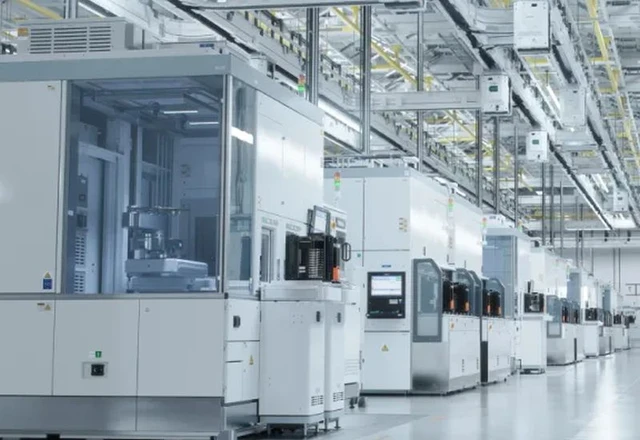 The Strategic Acceleration of India’s Semiconductor Industry
The global race for semiconductor sovereignty has long since evolved beyond a mere battle over nanometers, transforming into a critical imperative for national security and economic resilience. India is now vying for entry into this exclusive club by establishing its own silicon wafer fabrication infrastructure. Yet, the trajectory from ambitious blueprints to the first functional chip is invariably marked by a sobering encounter with the operational realities of semiconductor manufacturing. The case of Tata Electronics serves as a poignant example of how strategic objectives are recalibrated when confronted by sheer technological complexity and the pressures of tight timelines.
17 Jul 2026
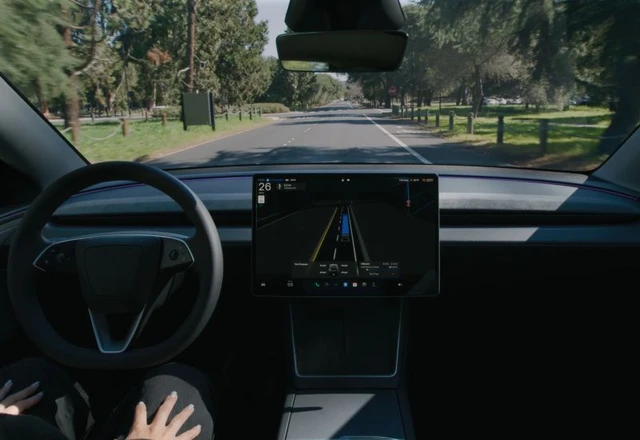 The Human Factor in the Age of Autopilot
Modern autonomous driving systems promise to liberate us from the drudgery of the road, yet in practice, they carve out a perilous zone of cognitive dissonance. The tragedy in Texas serves as a stark reminder of just how fragile the interface between driver and algorithm remains. When technology shifts into a state of passive monitoring, any lapse in human judgment can prove fatal. The investigation into this incident exposes a critical systemic flaw: the danger of over-reliance on automation.
