Modern user experience in delivery services has long since evolved beyond the mere utility of food procurement, transforming into a meticulously engineered mechanism designed to stimulate the brain's reward system. Often, the true gratification stems not from the meal itself, but from the curated process of selection, the mounting anticipation, and the hypnotic act of tracking a courier’s progress across a digital map. The FoodNeverComes project explores this boundary, offering users a distilled psychological ritual devoid of any physical outcome. It is, in essence, a digital experiment on consumerist addiction, where the primary value shifts to the act of waiting itself.
In an era of hyper-consumption, app interfaces are meticulously engineered to prolong the state of anticipation. It is during this phase that the brain releases dopamine—the neurotransmitter responsible for motivation and the pleasure derived from awaiting a reward. The FoodNeverComes project pushes this concept to its absolute limit, creating a flawless simulation of a food delivery service that, in reality, delivers nothing.
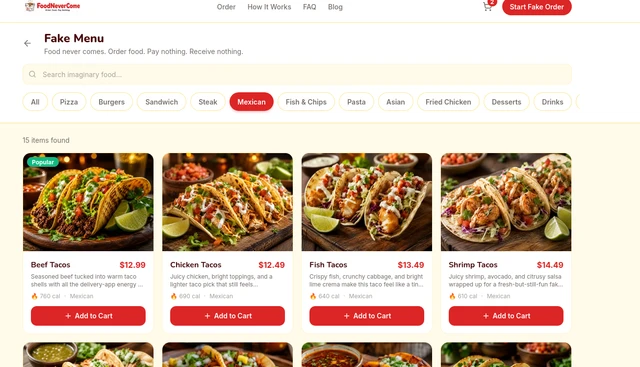
From a UX design perspective, the site employs classic e-commerce patterns: striking visuals, an intuitive menu catalog, and a familiar cart-filling flow. The user navigates through all the standard interaction stages which, in real-world applications, are punctuated by micro-interactions designed to sustain a state of arousal.
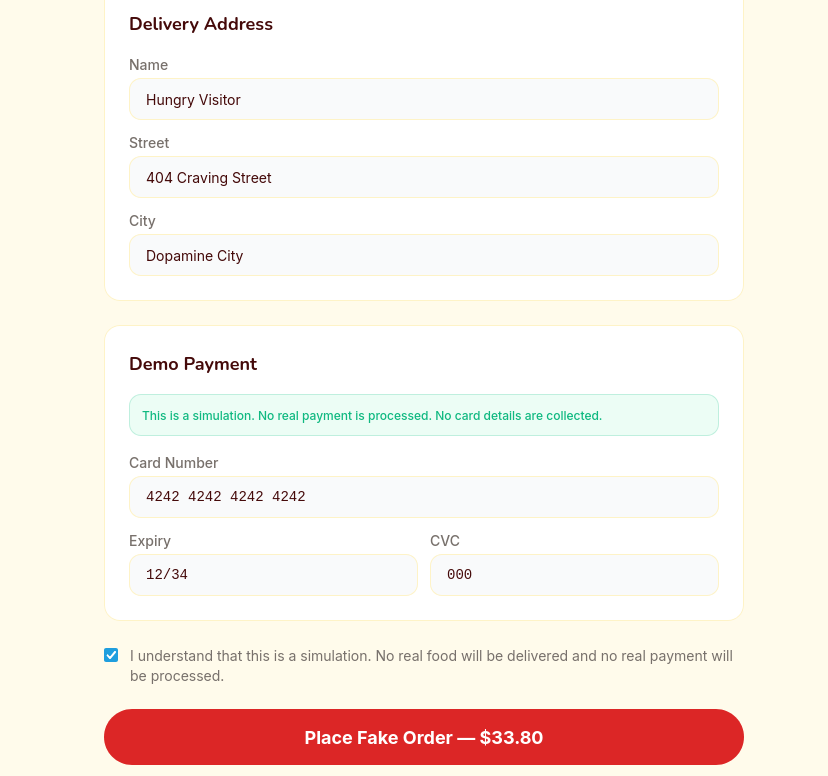
The process culminates in the checkout phase and virtual payment. Here, the project leverages the psychological trigger of "transactional closure." Although no actual funds are debited and the payment process is entirely fictitious, the brain perceives this as the point of no return, triggering the most intense phase of the dopamine cycle: anticipation.
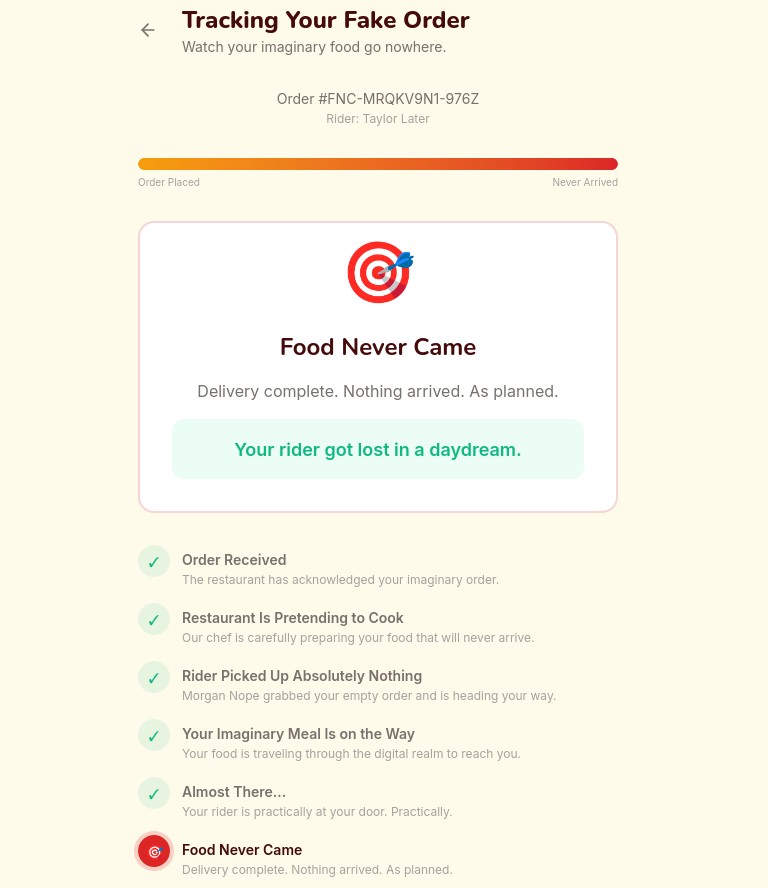
The final act is the simulated movement of the courier. Watching an icon migrate across a map toward the destination creates an illusion of reality and heightens the emotional response. However, the experience ends in a void: no food arrives at the door, and the order simply vanishes.
This project can be viewed as both a therapeutic instrument and a piece of social commentary. It exposes the addictive nature of the ordering ritual, which for many has become a component of daily stress management. FoodNeverComes demonstrates that a digital interface can satisfy the craving for novelty and anticipation without requiring actual resources—neither money nor calories. In doing so, the service transforms the act of consumption into a pure mental exercise, leaving the user alone with their own mechanisms of desire.
 Project Zenith: The Uncompromising Development Environment