In an era of pervasive digital surveillance, data privacy has emerged as the pivotal criterion for selecting enterprise software. For too long, the remote access market has been dominated by proprietary behemoths—closed-source incumbents that stifle customizability and obscure operational transparency. The rise of open alternatives is disrupting this paradigm, granting organizations total infrastructural sovereignty and guaranteed confidentiality. The latest release of HopToDesk (version 1.46.6) solidifies this trajectory, seamlessly blending the security of end-to-end encryption with comprehensive cross-platform flexibility.
The contemporary remote desktop landscape is undergoing a paradigm shift: cumbersome proprietary services are giving way to lightweight, transparent solutions. HopToDesk 1.46.6 stands as a prime example of this movement. At its core, the project is a highly refined fork of RustDesk, leveraging a powerful technology stack built on Rust and Dart, augmented by its own dedicated servers and an optimized user interface. This foundation ensures high performance and memory safety—critical requirements for applications handling real-time screen streaming.
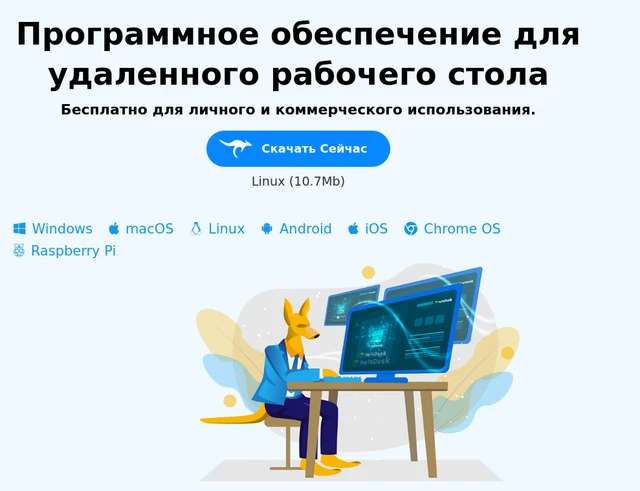
The product demonstrates remarkable versatility, supporting virtually every modern ecosystem: from the staples of Windows, macOS, and Linux to mobile platforms like Android and iOS, as well as specialized hardware such as Chromebooks and Raspberry Pi. This makes it an ideal toolkit for both casual users and system administrators managing heterogeneous device fleets.

A fundamental advantage of HopToDesk is its uncompromising commitment to privacy. The developers have implemented full end-to-end encryption (E2EE) for all traffic, eliminating the possibility of data interception or activity monitoring by the service provider. Equally notable is the absence of an artificial divide between "personal" and "commercial" use; the project's ethos dictates equal access to all functionality for every user, devoid of hidden licensing restrictions.
The solution's technical toolkit covers every essential scenario for modern IT support. Beyond basic screen control, the system supports unattended access—essential for maintaining server infrastructure without an operator present. Integrated Wake-on-LAN capabilities allow for remote system wake-ups, while two-factor authentication (2FA) provides a critical barrier against unauthorized access. To optimize professional workflows, the software includes clipboard synchronization, multi-monitor support, and session recording for subsequent analysis or documentation.
Deployment flexibility is achieved through two modes: a portable launch that leaves no footprint on the system, and a full installation. The latter creates a background service that constantly listens for incoming connections, ensuring seamless access to the device even after a reboot.
Recent iterations (versions 1.45.20–1.45.6) have focused on refining the user experience and expanding networking capabilities. Particular attention was paid to cursor scaling for HiDPI displays and the implementation of remote printing for Linux users. Technical evolution has also reached the network layer: optimizations to TURN relays, HTTP proxy support, and updated MCP mechanisms have significantly improved connection stability within complex corporate networks governed by restrictive firewall rules.
Parallel to the growth of HopToDesk, its upstream project—RustDesk—continues to evolve. The release of version 1.4.9 reaffirms the viability of the self-hosting paradigm, allowing organizations to deploy their own management servers under the GNU AGPL v3.0 license. This creates a comprehensive ecosystem where the user decides where their data resides and how traffic is routed, effectively breaking the dependency on centralized cloud services.
 Nvidia N1X and the New Era of Arm PCs