The open-source community’s migration toward a modern display server standard continues apace, steadily phasing out the legacy architecture of X11. The release of Wayland 1.26 marks another milestone in the ecosystem's stabilization process, signaling a shift in focus from foundational functionality to the granular optimization of component interoperability. In this iteration, developers have prioritized the resolution of critical race conditions and the expansion of support for cutting-edge hardware management. The result is a tool engineered for absolute rendering precision and a frictionless user experience.
Wayland 1.26 represents the next logical step in the evolution of a protocol designed to redefine the fundamental principles of graphics servers and inter-process communication (IPC). Maintaining full backward compatibility at both the API and ABI levels with previous versions of the 1.x branch, this release eschews radical upheaval in favor of meticulous polishing and the resolution of accumulated technical debt. The entire codebase remains available under the MIT license, underscoring the project's commitment to openness and community-driven development. Central to this ecosystem is Weston, the reference compositor, which continues to serve as a living laboratory for implementing new features across both desktop environments and embedded systems.
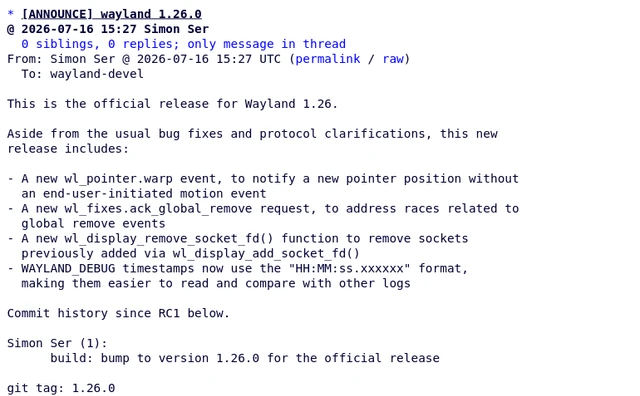
Technical refinements within the protocol core are aimed at enhancing determinism and application stability. A key addition is the wl_pointer.warp event, which enables notifications regarding pointer movement without the need to process standard user-generated motion events. This is critical for implementing complex cursor management scenarios where programmatic positioning is required without introducing noise into the event stream.
Simultaneously, the developers have addressed race conditions associated with the removal of global events. The introduction of the wl_fixes.ack_global_remove request allows a client to signal the compositor that event processing has ceased. Only after receiving these acknowledgments from all active clients can the server safely remove the corresponding handler, significantly increasing system reliability during dynamic resource reconfiguration. For developers, the addition of wl_display_remove_socket_fd() provides more flexible socket management, while the WAYLAND_DEBUG mode now features granular timestamped logs, greatly simplifying timing analysis and the identification of performance bottlenecks.
Particular attention should be paid to the evolution of extensions within the Wayland-Protocols suite, which effectively define the capabilities of modern desktop environments. For a long time, fractional scaling remained a primary pain point for HiDPI displays. The introduction of xx-fractional-scale shifts the logical coordinate system from integers to higher precision, allowing elements to be positioned with single-pixel accuracy. This eliminates interface blurriness and ensures flawless rendering at non-standard scales.
Adaptation for modern hardware continues with xx-cutouts, which allows applications to account for camera notches on smartphone and laptop screens, ensuring critical UI elements are not physically obscured. Meanwhile, the xx-zones extension introduces a new approach to window organization: windows can now be grouped into zones with their own coordinate spaces, creating complex logical dependencies in screen layout.
On the system management and security front, the xx-keyboard-filter extension has been introduced, allowing input events to be intercepted or modified before they reach the active window. In the "staging" category, the xdg-session-management protocol addresses the fundamental challenge of session state recovery following a compositor or application crash, bringing Unix-like systems closer to the fault-tolerance levels of professional workstations.
The Wayland 1.26 technology stack also makes significant strides toward multi-processor configurations and high-fidelity content. Multi-GPU support within the linux-dmabuf protocol allows clients to coordinate the use of specific graphics accelerators with the server, optimizing load distribution. Rounding out these updates is support for BT.2100 metadata in color-management-v1. This paves the way for the correct rendering of HDR content created under Windows standards, ensuring visual consistency and color accuracy regardless of the media file's platform of origin.
 Nvidia N1X and the New Era of Arm PCs