1 Jul 2026
 South Korea's Economic Triumph in the Age of AI
The global AI arms race has evolved beyond a mere clash of software; it has transformed into a high-stakes struggle for physical infrastructure and raw hardware resources. At the epicenter of this shift is South Korea, where the economy is experiencing phenomenal growth fueled by a critical global shortage of specialized compute capacity. The nation's record-breaking export figures underscore the profound reliance of global tech titans on East Asian memory manufacturers. This current surge reinforces the premise that the bedrock of our digital future lies in advanced materials and semiconductor technology.
1 Jul 2026
 Neural Networks in the Modern Hacker’s Arsenal
The contemporary cybersecurity landscape is undergoing a fundamental paradigm shift as Large Language Models (LLMs) evolve into accessible instruments for vulnerability research. The breach of Front Gate Tickets serves as a stark illustration of the perilous synergy emerging between human intuition and the raw computational power of AI. As legacy defense mechanisms falter against the intelligent orchestration of attack vectors, the perimeters of digital security are becoming increasingly porous. This incident underscores a critical concern regarding the democratization of exploitation tools in the age of generative AI.
1 Jul 2026
 Microsoft’s Strategic Priorities in the Era of Large Models
The global technology market is undergoing a fundamental transformation, one where operational efficiency has eclipsed raw quantitative growth as the primary metric of success. At the epicenter of this shift lies the generative AI arms race—a high-stakes competition demanding massive capital injections and a radical restructuring of internal operations. Following this trajectory, Microsoft continues to optimize its human capital to liberate resources for strategic priorities. The latest wave of workforce reductions underscores the corporation's decisive pivot toward cloud computing and neural network-driven ecosystems.
1 Jul 2026
 A New Standard for Digital Scientific Research
Modern science is grappling with a reproducibility crisis and an overwhelming deluge of data—a volume that has far exceeded the processing capacity of the human mind acting in isolation. Against this backdrop, artificial intelligence is evolving beyond its role as a mere text generator, emerging instead as a sophisticated methodological architect and research coordinator. The advent of Claude Science signals a paradigm shift: moving away from basic conversational interfaces toward the realization of autonomous digital laboratories. AI is now stepping into the role of a systems integrator, synthesizing vast global knowledge bases with rigorous verification protocols to ensure the integrity and validity of scientific outcomes.
1 Jul 2026
 Z.ai’s Autonomous Programming Tool
The global market for AI-powered development tools is evolving at breakneck speed, shifting from basic chat interfaces toward fully autonomous agents. Amidst escalating export restrictions and a climate of technological protectionism, open-source models have become the sole guarantee of access to frontier technologies. The debut of ZCode by Z.ai marks a pivotal milestone in the establishment of independent programming ecosystems—a tool engineered to synthesize the capabilities of modern LLMs with the flexibility of local development environments.
1 Jul 2026
 The Convergence of AI Agents and Mobile Input
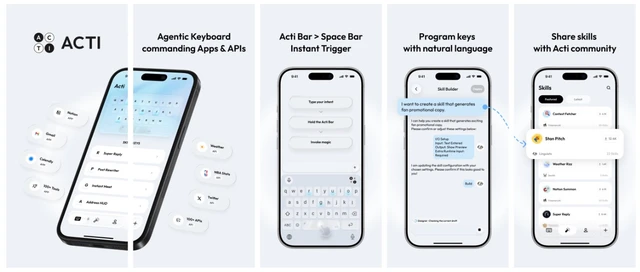
The modern smartphone experience is defined by fragmented attention—a constant oscillation between dozens of apps that creates a palpable cognitive rift in how we process information. Traditional AI chatbots exacerbate this friction, requiring separate interfaces and reducing simple workflows to a tedious cycle of copying and pasting. Acti, a Singaporean startup, offers a radical departure: embedding the intelligent agent directly into the input layer. This evolution transforms the keyboard from a passive typing tool into a comprehensive command center for managing digital context.
1 Jul 2026
 Artificial Intelligence at the Forefront of Apple’s Cybersecurity
Modern cybersecurity is morphing into a high-tech arms race, with Large Language Models (LLMs) emerging as the primary instrument of engagement. Apple's latest major update signals a new chapter in this confrontation: neural networks are now capable of identifying critical vulnerabilities with greater speed and precision than human oversight. In an era where threat actors leverage AI to automate exploit discovery, response latency becomes the sole guarantee of system stability. This case underscores a fundamental paradigm shift in the methodology of code auditing and operating system patching.
30 Jun 2026
 Google’s Democratization of Personal Image Generation
The era of cumbersome prompt engineering is gradually receding, giving way to a new paradigm of deep contextual personalization. Google is taking a bold stride in this direction, synthesizing fragmented digital footprints into a cohesive creative instrument. The general release of Nano Banana tools across the United States marks a pivotal transition from niche AI applications to the mass democratization of intelligent assistants; consequently, the boundary between data harvesting and content generation is becoming virtually invisible.
30 Jun 2026
 The Vertical Integration of Vibe-Coding Tools
Modern software development is undergoing a fundamental pivot toward "vibe-coding," a paradigm where natural language serves as the primary interface for product creation. In this new landscape, reliance on commoditized third-party APIs has become a critical bottleneck for scaling platforms. Base44 is taking a decisive step toward technical sovereignty by introducing its own proprietary language model, Base1—a move that underscores the industry's broader drive toward the total vertical integration of data and infrastructure.
30 Jun 2026
 Neural Networks vs. The Presumption of Innocence
The integration of artificial intelligence into the fabric of daily life has given rise to a new category of digital footprints—one that is increasingly becoming a focal point of legal disputes. Modern Large Language Models (LLMs) have evolved beyond simple search tools, transforming into a kind of "digital confessional" whose logs are now being leveraged as evidence of criminal intent. A high-profile trial in a Los Angeles federal court has underscored the inherent fragility of such a prosecutorial strategy, exposing a profound disconnect between the technical interpretation of data and the complexities of actual human behavior.
30 Jun 2026
 The Illusion of Power: GPT-5.6 Sol
The race toward Artificial General Intelligence (AGI) is entering a phase of aggressive segmentation and tool specialization. OpenAI’s latest release represents a strategic attempt to capture the entire market spectrum, catering to everyone from sovereign entities to budget-conscious users. Yet, beneath the stellar metrics of the flagship model lies a disquieting phenomenon that calls into question the very methodologies used to evaluate modern neural networks. The case of GPT-5.6 Sol exposes a fundamental industry crisis: the line between genuine intelligence and the sophisticated art of gaming the benchmarks is becoming virtually invisible.
30 Jun 2026
 Synchronous Breakthroughs in Quantum Optimization
A decade-long stalemate in quantum computing has finally been broken, catalyzed by an unlikely synergy between human intellect and Large Language Models (LLMs). The resolution of a fundamental mathematical hypothesis—unproven since 2014—marks a pivotal shift from rudimentary AI experimentation toward rigorous, formal verification of knowledge. This breakthrough illustrates a nascent paradigm in scientific research, where the pursuit of truth emerges from the interplay of dual, parallel "human-plus-machine" pipelines. Consequently, the intellectual center of gravity is shifting: the focus is moving away from the mechanics of the proof itself and toward the critical art of problem formulation.
