The line between automated image generation and professional graphic design is blurring at an accelerating pace. ByteDance’s new flagship model, Seedream 5.0 Pro, introduces a radical paradigm shift, transforming the neural network's static canvas into a structured project featuring independent layers. This innovation is designed to solve the primary pain point of contemporary generative AI: the lack of precise, non-destructive editing capabilities. Consequently, the creative process is evolving from a "prompt lottery" into a controlled, iterative professional workflow.
Unveiled at the Volcano Engine FORCE conference, Seedream 5.0 Pro positions itself as the definitive tool for the modern digital artist and designer. While most contemporary diffusion models produce "flat" outputs that necessitate tedious post-processing in third-party software, ByteDance’s latest development integrates the logic of professional design suites directly into the generative process.
The core technological leap is the implementation of an independent layering system. The model is capable of decomposing the final image into discrete elements, which can be isolated via text prompts or selection tools. The granularity of this approach is striking: it ranges from entire layout blocks and major objects down to individual lines of text or even single characters. Each fragment becomes a discrete object that can be moved, scaled, or modified without affecting the rest of the composition. In essence, the neural network is evolving from a mere "image generator" into a sophisticated editor that understands the spatial and structural hierarchy of the frame.
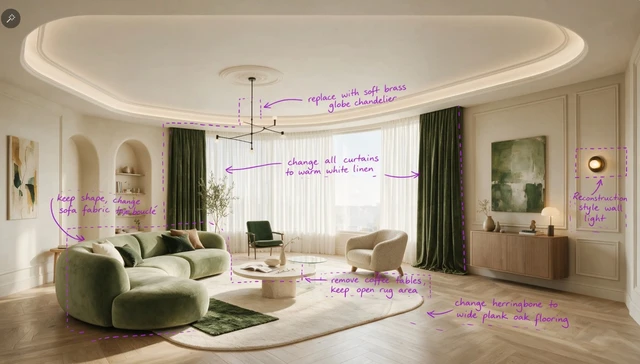
Alongside this layered approach, Seedream 5.0 Pro introduces mechanisms for interactive steering. Rather than enduring the tedious cycle of prompt engineering, users can interact with the image directly—drawing directional arrows, circling areas for correction, or providing low-fidelity sketches with annotations. The model interprets these visual cues as actionable instructions. This is most evident in its sketch-to-final-product mode, where a rough, hand-drawn mockup of a landing page is transformed into a detailed, production-ready user interface.
Particular attention has been paid to "informational density" and typography—areas that have traditionally been the Achilles' heel of generative models. Seedream 5.0 Pro demonstrates a refined ability to create complex, structured visual data: multi-level diagrams, detailed graphs, and full presentation slides where every element is precisely positioned.
The model's linguistic versatility has also reached a new milestone. Support for over ten languages is achieved not through simple translation, but through a deep understanding of indigenous typographic conventions and layout rules. This enables the creation of accurate Arabic posters with correct right-to-left orientation, authentic Japanese manga, or complex compositions in Bengali, all while maintaining typographic elegance and aesthetic coherence.
Despite this impressive demonstration of capabilities, ByteDance maintains a degree of opacity. To date, there are no detailed white papers, benchmarks, or data regarding API pricing. In the absence of objective metrics, it is difficult to draw a direct comparison between Seedream 5.0 Pro and competitors such as Google's Nano Banana 2 or OpenAI's GPT Images 2. Nevertheless, the strategic trajectory—shifting from "single-shot" generation to the creation of a controllable, multi-layered project—sets a new benchmark for the entire visual AI industry.
 The Evolution of Rendering in DLSS 4.5