The LLM arms race is shifting from a blind pursuit of benchmarks to an era of rigorous pragmatism. The release of SpaceXAI’s Grok 4.5 signals a paradigm shift, one where cognitive capacity is increasingly measured through the lens of economic viability. By integrating deep data from the Cursor development environment, the model has been transformed into a precision instrument for professional software engineering. This is more than a mere algorithmic iteration; it is the culmination of a sweeping strategy to unify SpaceX’s infrastructure with Anysphere’s intellectual assets.
The arrival of Grok 4.5 marks the logical culmination of xAI’s transformation into SpaceXAI. At its core lies the V9 base model, boasting a staggering 1.5 trillion parameters. Yet, the true value of this release lies not in the sheer scale of the neural network, but in the quality of the data used for its fine-tuning. SpaceXAI has pursued a strategy of deep vertical integration, underscored by the $60 billion acquisition of Anysphere, the creators of the popular Cursor editor.
This acquisition granted access to a unique corpus of data reflecting actual developer behavior. By integrating Cursor’s engineering methodologies into its Supervised Fine-Tuning (SFT) and Reinforcement Learning (RL) processes, the model has mastered complex, multi-step development cycles. Unlike many competitors that rely on static datasets, Grok 4.5 has absorbed the dynamics of real-time code authorship, rendering it far more adaptive to real-world programming challenges.
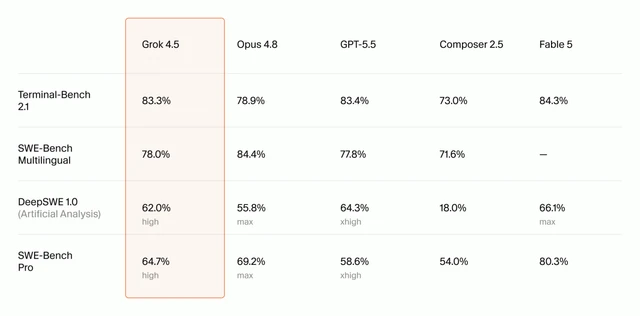
In an industry obsessed with showcasing triumphalist benchmark results, SpaceXAI has adopted a surprisingly candid approach. In the official announcement, the model does not claim the top spot in any of the five key tests. In disciplines such as DeepSWE 1.1, SWE Bench Pro, and SWE-Bench Multilingual, Anthropic’s Fable (max) maintains its lead. Nevertheless, Grok 4.5 proves highly competitive, outperforming Opus 4.8 (max) in Terminal Bench 2.1 and DeepSWE 1.0. This transparency suggests that the company is no longer chasing nominal leaderboard dominance, focusing instead on applied utility.
The primary developmental vector for Grok 4.5 has been computational economics. The developers introduced the concept of "maximum intelligence per unit of time and cost." The model delivers impressive generation speeds of up to 80 tokens per second. However, the more critical metric is its conciseness: when tackling SWE Bench Pro tasks, the model averages 15,954 output tokens—4.2 times fewer than those required by Opus 4.8 (max) to achieve a similar result.
This reduction in generated text, without compromising the quality of the solution, translates to a drastic reduction in API overhead and lower latency for the end user. For enterprises, this shifts AI from a costly experiment to a scalable, production-grade tool.
Currently, access to Grok 4.5 is primarily open to developers. The model is already integrated into the Grok Build agent and available across all Cursor subscription plans, which include a limited free trial. For those preferring their own infrastructure, an API has been launched with pricing set at $2 per million input tokens and $6 per million output tokens. Full-scale deployment on grok.com and within mobile applications is expected later, with the European Union market launch slated for mid-July.
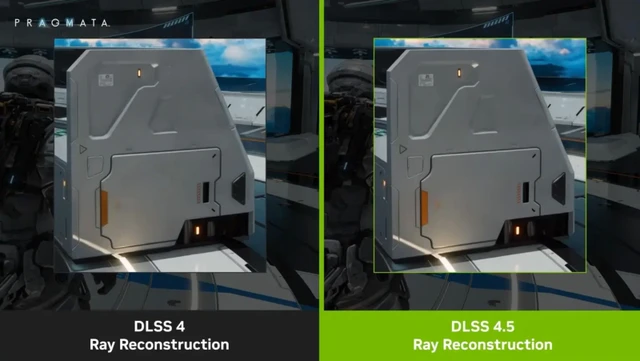 The Evolution of Rendering in DLSS 4.5