For decades, the quest for the ideal thermal insulator has been defined by a persistent trade-off: materials with low thermal conductivity are typically porous and fragile, while durable materials tend to be thermally conductive. Conventional solutions, such as aerogels and foams, achieve their efficiency by incorporating air-filled voids—a structural necessity that inevitably compromises mechanical resilience. Researchers at North Carolina State University have now broken this deadlock, developing a dense material that operates at the very edge of the theoretical limit for thermal conductivity. This breakthrough redefines the possibilities for protective coatings engineered for extreme environments.
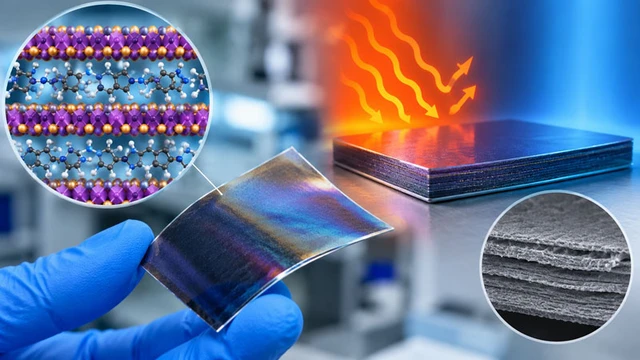
At the heart of this technological breakthrough lies the use of a two-dimensional hybrid organic-inorganic perovskite—specifically, azobenzene-ethylammonium lead iodide. Perovskites have long captivated the scientific community due to their unique crystalline structure, characterized by alternating layers of organic and inorganic compounds. However, it is the precise molecular engineering of these layers that has unlocked these anomalous properties: the material remains dense and rigid, yet has become virtually impervious to heat.
From a physical standpoint, heat transfer in solids occurs via phonons—the quanta of lattice vibrations. To impede this process, researchers modified the organic component of the structure, replacing specific carbon chains with carefully selected benzene fragments. This created a sophisticated "filter" that effectively suppresses the propagation of thermal vibrations without compromising the overall structural rigidity.
The empirical results are striking. The thermal conductivity of the new film at room temperature is approximately 0.04 W/(m·K). For comparison, industrial-grade silicone typically sits around 0.2 W/(m·K), making this new material five times more efficient. Simultaneously, its elastic modulus reaches 7.7 GPa, rendering it hundreds, if not thousands, of times stiffer than traditional polymer insulators.
A pivotal distinction here is the total absence of porosity. Unlike aerogels, which inhibit heat transfer by trapping air within micropores, this material functions through the intrinsic molecular architecture of the substance itself. This paves the way for the development of ultra-thin yet incredibly robust thermal shields.
The manufacturing viability of this solution also plays a critical role. The films are produced via spin-coating: a solution is applied to a substrate and rotated at high speeds to form a perfectly uniform, thin layer. This approach is easily scalable for industrial production, allowing the insulation to be applied directly onto device components.
The real-world implications of this development are vast. In electronics, such coatings could protect sensitive components from overheating without increasing the device's footprint with bulky gaskets. In the aerospace sector, where materials endure colossal mechanical loads and extreme temperature fluctuations, the combination of high rigidity and low thermal conductivity is mission-critical. Even in the consumer segment—such as high-end kitchen appliances—this insulation would enable the creation of devices that remain cool to the touch while remaining structurally monolithic and durable.
 Breaking the Lithography Barrier in China