The pursuit of fundamental breakthroughs in high-energy physics is inextricably linked to our capacity to manipulate elementary particle beams with absolute precision. For decades, Western laboratories maintained a virtual monopoly over the cutting-edge superconducting technologies essential to the operation of particle colliders. Recent developments in China, however, signal a profound paradigm shift and a recalibration of the global technological equilibrium. This pivot—from the importation of critical hardware to its export—heralds a new era of scientific autonomy and technical hegemony.
At the core of every modern particle accelerator lies the ability to focus electron and positron beams, maximizing the probability of their collision. The smaller the transverse beam size at the interaction point, the higher the facility's luminosity—the primary metric for any collider's efficiency. Achieving such precision requires superconducting magnets of exceptional power and accuracy, capable of operating under extreme cryogenic conditions.
The trajectory of the Beijing Electron-Positron Collider (BEPCII) vividly illustrates this evolution of technological dependence. During a major upgrade completed in 2009, China relied heavily on the expertise of the U.S.-based Brookhaven National Laboratory (BNL). At the time, American specialists designed and manufactured the critical superconducting components that propelled the facility to new performance levels. It was a classic paradigm of technology transfer: the leader providing the blueprint for the follower.
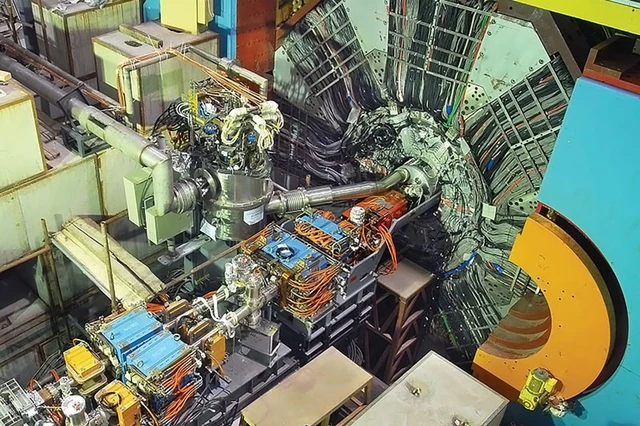
However, the landscape shifted dramatically with the launch of the BEPCII-U program. Initiated in 2021, this modernization effort was not merely about refreshing hardware; it was a strategic push toward full localization. The result is a new generation of combined superconducting magnets that now perform the critical function of final beam focusing immediately prior to the collision point.
The technical breakthrough lies in a significant increase in the nominal quadrupole field gradient—rising from 18.7 to 25 T/m. This was achieved through a direct "serpentine" coil winding technique, enabling a denser and more efficient conductor configuration. The system operates under deep cryogenic cooling at temperatures between 4.2 and 4.5 K (approximately −269 °C), ensuring superconductivity while minimizing energy loss.
Beyond the primary focusing element, these modules incorporate an anti-solenoid designed to compensate for the magnetic field of the BESIII detector, preventing particle trajectory distortion. Together, these engineering innovations have produced a device that outperforms its American counterpart by 40%.
Symbolically, by May 2025, the vector of technological exchange has performed a complete 180-degree turn. Brookhaven National Laboratory, once the mentor and supplier, has approached the Chinese Institute of High Energy Physics (IHEP) with an offer to purchase these new magnets. A development cycle spanning thirteen years of intensive labor has transformed China from a consumer of Western technology into a primary exporter within the specialized niche of superconducting electronics.
This case underscores a fundamental pattern in high-tech industrial development: strategic localization and the deep assimilation of external expertise inevitably lead to the creation of superior, proprietary solutions. The success of IHEP is more than just an engineering victory; it is evidence that the center of competence for superconducting systems is shifting toward the East.
 Next-Generation Ultra-Lightweight Lens Technology