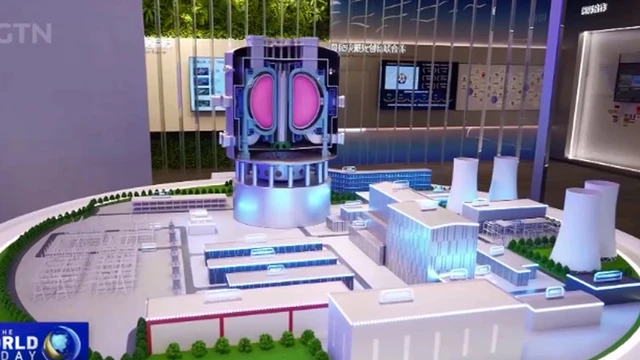
For decades, the quest for a virtually inexhaustible source of clean energy has remained the primary objective of global fundamental science. Harnessing plasma heated to hundreds of millions of degrees demands absolute engineering precision and the deployment of cutting-edge materials. China's Huanliu-4 project marks a pivotal transition from theoretical exploration toward the development of scalable technological solutions. This facility is envisioned as the final bridge leading to the realization of full-scale thermonuclear power plants.
The pursuit of an "artificial Sun" on Earth transcends mere ambition; it is a strategic quest to resolve the global energy crisis. At its core, nuclear fusion involves the merging of light atomic nuclei—typically isotopes of hydrogen, namely deuterium and tritium. Unlike traditional nuclear fission, this process generates no long-lived radioactive waste and offers an extraordinary energy density. However, the primary obstacle lies in the fundamental physics: to overcome electrostatic repulsion, the matter must be heated to temperatures exceeding those found within the core of the Sun.
Under these extreme conditions, matter transitions into plasma—a volatile and aggressive stream of charged particles. The only effective method for containing this "solar fire" is magnetic confinement. The Tokamak, a toroidal chamber, generates powerful magnetic fields that force the plasma into a closed spiral, preventing it from contacting the reactor walls. Yet, even within such systems, turbulence and energy leakage remain critical barriers to achieving a self-sustaining reaction.
The Huanliu-4 project aims to shift the paradigm by introducing a fundamentally new approach to magnetic system design. The pivotal technological leap is the integration of High-Temperature Superconductors (HTS). Unlike conventional systems, HTS allows for magnetic field induction of up to 25 Tesla. This value is critical: a stronger magnetic field ensures tighter plasma confinement, allowing for a more compact reactor. Enhancing magnet efficiency directly impacts the economic viability of future power plants, reducing the installation's footprint while maintaining or increasing power output.
Beyond the magnetic system, Huanliu-4 focuses on two fundamental challenges: materials science and plasma control. The first is the integrity of the reactor's "first wall." High-energy neutron fluxes generated during fusion gradually degrade material structures, leading to embrittlement and erosion. The project will test innovative shielding methods and advanced alloys capable of withstanding extreme radiation loads.
The second challenge is the dynamic instability of the plasma. To mitigate this, developers are integrating AI-driven control systems. Neural networks can analyze the state of the plasma column in real-time and adjust magnetic fields within milliseconds, preventing the disruptions and collapses that typically force a shutdown in traditional installations.
The implementation of the project is systemic. The technological foundation is being established at the CRAFT research center in Hefei, with a specialized production line for superconducting magnets slated for launch by 2028. The entire manufacturing cycle for reactor components will be centralized within a new, large-scale production complex, ensuring seamless synchronization between engineering development and assembly.
Huanliu-4 is expected to be fully assembled by the early 2030s. While it will not serve as a commercial energy source, it will function as a critical testbed. Its primary objective is to validate the viability of high-field magnets and intelligent plasma management, paving the way for the first full-scale demonstration fusion power plant—a milestone that would permanently redefine humanity's energy landscape.
 Starship's Return from the Indian Ocean