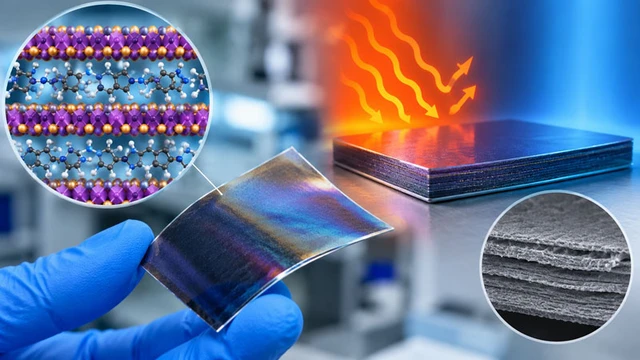
For decades, modern photovoltaics have been constrained by a rigid theoretical efficiency ceiling that limits the performance of most solar cells. The core issue lies in the rapid energy dissipation of "hot" electrons, which waste valuable potential by converting it into useless heat. Researchers at the University of Groningen have discovered a method to decelerate this process by a factor of a thousand, leveraging the unique properties of tin-based materials. This breakthrough paves the way for a new generation of solar panels capable of shattering the classical efficiency limit.
At the heart of every solar panel lies the fundamental process of converting light quanta—photons—into electrical current. When a photon interacts with a semiconductor, it transfers its energy to an electron, propelling it into an excited state. The most energetic photons generate what are known as "hot electrons." Theoretically, these particles could provide a significantly higher electrical yield; however, in practice, they lose their excess charge almost instantaneously, dissipating it into the material's crystal lattice as heat. This process, known as thermalization, is the primary culprit behind the efficiency ceiling of standard single-junction solar cells, which is capped by the Shockley-Queisser limit at approximately 33%.
Finding ways to harness the energy of hot electrons has become the "holy grail" of modern semiconductor physics. Recent research into tin-based materials has yielded an anomalous result: the electron cooling time in these structures is a thousand times longer than in traditional materials. This means that energy remains available for extraction for a significantly longer duration, potentially allowing for a radical increase in the efficiency of solar radiation conversion.
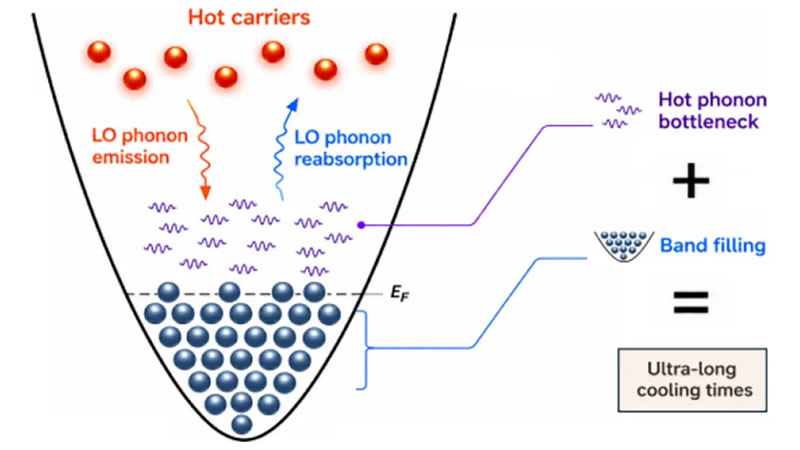
An analysis of the underlying physical processes reveals that this impressive effect is not the result of a single factor, but rather the synergy of two independent mechanisms. The first is the "hot phonon bottleneck." Under normal conditions, electrons transfer energy to phonons—quanta of lattice vibrations. However, in the material under study, the surrounding environment heats up so rapidly that a form of thermal congestion occurs. Electrons begin to re-absorb this thermal energy, effectively reclaiming it, which allows them to remain in a "hot" state for longer.
The second mechanism is the Burstein-Moss effect, which operates on the principle of energy level occupancy. According to the laws of quantum mechanics, electrons seek to occupy the lowest available energy states. When these lower levels are rapidly filled, a "bottleneck" occurs: other hot electrons simply have nowhere to "drop" to shed their energy. This process can be compared to passengers boarding an aircraft: once the front rows are occupied, others must move further back into the cabin, significantly slowing the overall seating process.
The combination of these two effects creates unique conditions where the electronic, phononic, and chemical components of the material work in concert. Under intense illumination, such a system transforms into an efficient energy reservoir that resists the system's natural tendency toward cooling.
The practical implementation of this discovery in commercial solar cells could trigger a technological leap. Breaking the 33% efficiency threshold would represent a paradigm shift in the economics of renewable energy, enabling greater electricity generation from the same panel surface area. The research, published in ACS Energy Letters, confirms that managing electron cooling dynamics is the key to developing next-generation photovoltaic cells.

 Breaking the Lithography Barrier in China