The global race for AI supremacy has shifted decisively from the realm of algorithms to the realm of physical infrastructure. The insatiable demand for massive computational power has triggered an unprecedented surge in the semiconductor manufacturing equipment market. Current projections suggest the industry is heading toward all-time highs, expected to peak by 2028. This trajectory signals a fundamental transformation across the entire semiconductor value chain.
Tellingly, the forecasts from SEMI regarding the chip manufacturing equipment market align closely with the optimistic projections of ASML—the world's primary supplier of lithography systems. The company has reaffirmed its intention to increase shipment volumes by 30% both in the immediate future and leading up to 2028. Collectively, this points toward staggering figures: revenue from specialized equipment shipments is expected to hit a record $229.5 billion.
This five-year expansion cycle is a direct byproduct of the generative AI boom. Modern neural networks demand an exponential increase in computational power, which automatically stimulates demand for more sophisticated semiconductor components and, by extension, the machinery required to produce them. In the current year alone, revenue in this segment is projected to grow by 23.2%, reaching $165.9 billion. When narrowing the focus to wafer fabrication equipment (WFE), the trajectory is equally robust: climbing from a record $116.9 billion last year to a projected $200 billion by 2028.
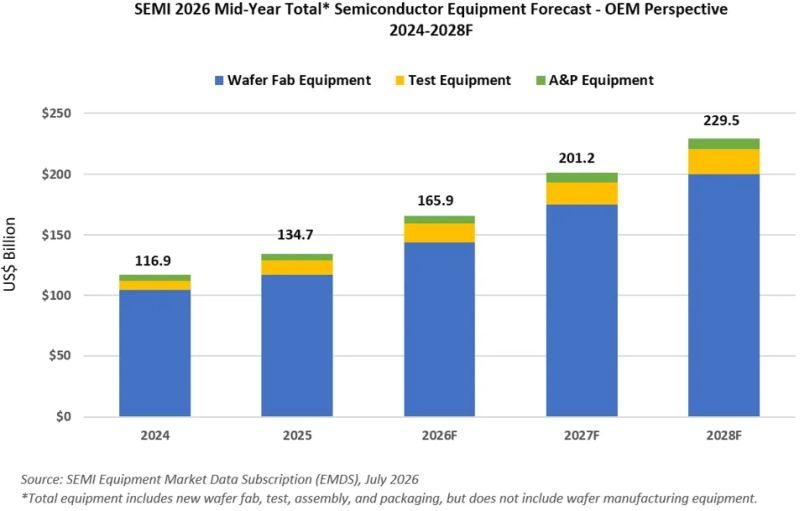
Particular attention should be paid to testing and packaging processes. In the era of AI, these stages are evolving from auxiliary steps into critical bottlenecks. Modern chips are becoming increasingly complex in terms of architecture; we are seeing a shift toward multi-layered structures and the adoption of 2.5D and 3D Advanced Packaging to minimize data latency between the compute core and memory. This explains the rapid revenue growth in the testing segment, which is poised to reach $20.8 billion by 2028, and packaging, which is expected to hit $8.6 billion.
In terms of functional verticals, contract manufacturing for logic components remains the most dynamic sector, driven primarily by compute accelerators and high-performance mobile processors. This market is expected to reach $104.7 billion by 2028. A pivotal technological milestone will be the mass adoption of 2nm process nodes, where traditional FinFET transistors will be superseded by Gate-All-Around (GAA) structures, offering superior leakage current control and enhanced power efficiency.
Parallel to this, the memory segment is providing a "second wind" for AI infrastructure. Demand for high-speed DRAM is fueling an aggressive surge in revenue: a 39% jump to $38.8 billion is expected this year, with the figure climbing to $56.9 billion by 2028. The NAND flash segment is following a similar trajectory, with projected revenues of $20.8 billion by the end of the five-year cycle.
The industry's geopolitical map remains conservative, despite U.S. efforts to onshore production. China, Taiwan, and South Korea maintain their dominant positions. China will remain the largest buyer of equipment, even accounting for temporary fluctuations caused by the high base effect of previous years. Taiwan will continue to focus on leading-edge nodes, while South Korea solidifies its status as the world's primary "foundry" for memory chips. Meanwhile, other regions are expected to see a notable increase in investment toward 2027–2028, resulting from the implementation of national strategic programs to develop domestic semiconductor industries.

 The Horizon of China's Technological Sovereignty in Lithography