Efficient heat dissipation remains the primary bottleneck in the development of ultra-high-performance computing systems. Classical physics treats heat transfer as a stochastic process of diffusion, radiating uniformly in all directions. Quantum mechanics, however, presents a fundamentally different paradigm: one where thermal energy can propagate as focused waves. Recent breakthroughs in materials science have enabled the observation of this phenomenon at room temperature, challenging our fundamental understanding of thermodynamics. This discovery paves the way for a new generation of cooling architectures.
At the core of every thermal process is the transport of energy, which in solids is carried by quasiparticles known as phonons. Essentially, phonons are the quanta of lattice vibrations. In the classical understanding, heat propagates diffusively: phonons constantly collide with one another and interact with structural defects and crystal boundaries, leading to the chaotic scattering of energy. Consequently, the thermal footprint expands uniformly—much like a drop of ink in water—making the control of such flows exceptionally difficult.
For a long time, the wave-like, or ballistic, properties of heat transport were observed exclusively at cryogenic temperatures, where atomic thermal motion is minimal and the probability of phonon collisions drops sharply. However, implementing such conditions in modern electronics is practically impossible.
The turning point came with the use of boron arsenide, a material possessing unique physical properties. In this crystal, phonon scattering mechanisms are significantly weaker than in most known semiconductors. This allows vibrational quanta to maintain their coherence and wave-like nature over much greater distances, even when the system is not in a state of deep freeze.
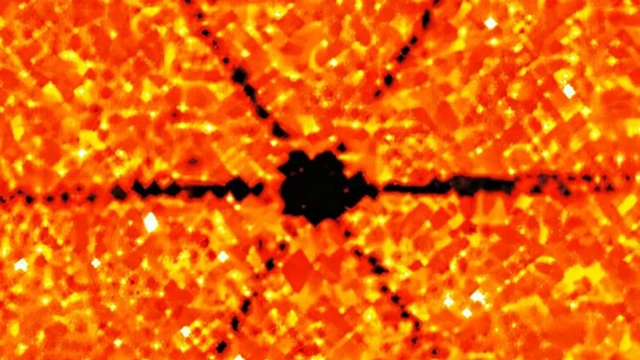
To capture this phenomenon, researchers employed nanoscale thermal mapping. A gold nanowire, integrated directly into the material's structure, served as both the heat source and the sensor. The experimental results were groundbreaking: instead of the expected circular diffusion of heat, the researchers recorded clearly defined beam-like structures.
The geometry of these "heat beams" proved to be directly dependent on the crystallographic orientation of the material. Depending on the lattice plane, four-, six-, and eight-fold beam patterns were observed, aligning perfectly with theoretical models of quantum transport. This proves that in such systems, heat behaves not like a gas striving to fill a volume, but as a directed flow.
The observation of focused heat transport at ambient room temperature (27°C) elevates this phenomenon from a theoretical curiosity to the realm of applied technology. The ability to precisely control the direction of phonon movement opens fundamentally new horizons for microelectronics design.
Rather than attempting to passively dissipate heat across the entire surface of a heat sink, the engineers of the future will be able to literally "steer" thermal flows. This will enable the efficient extraction of energy from critical components—such as the cores of high-performance AI accelerators or elements of quantum processors—and redirect it into specialized discharge zones. In this way, the structure of the material itself becomes an active tool for thermal management, allowing for the creation of chips with power densities previously considered unattainable due to the risk of overheating.
 Semiconductors for 600°C Operation