For too long, thermodynamics has been perceived as a domain of immutable constraints and irreversible processes. The traditional principle of reciprocity governed the paradigm: heat absorption and emission were viewed as symmetric counterparts, severely limiting the potential for precision energy management. However, a pioneering breakthrough by Japanese researchers is fundamentally shifting our approach to managing heat flux. The development of materials with programmable emissivity paves the way for a new generation of devices where thermal energy becomes as flexible and controllable a resource as electrical current is in modern electronics.
At the heart of classical heat transfer lies the principle of reciprocity. According to this rule, any material that absorbs thermal radiation of a specific wavelength from a given direction must inevitably emit it in exactly the same way. For engineers, this symmetry has long acted as a "glass ceiling"; the inability to independently control absorption and emission precluded the creation of systems with unidirectional heat flow. Breaking this link would provide humanity with a tool to steer thermal energy with unprecedented precision, radically altering the fundamentals of thermoregulation and infrared data transmission.
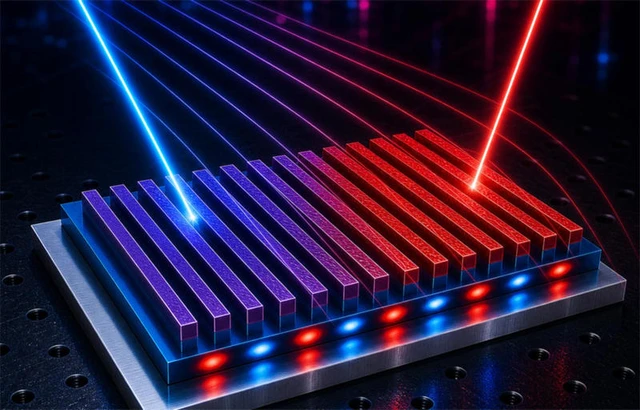
A solution to this challenge has been developed by researchers at the Higher Engineering School of Osaka Metropolitan University. The breakthrough came through the synthesis of two types of materials with unique properties. The team combined magneto-optical materials—whose characteristics shift under the influence of an external magnetic field—with phase-change materials, specifically a compound of germanium, antimony, and tellurium (GST).
The synergy between these components has enabled the creation of a device capable of altering the direction of thermal radiation. Crucially, the established state is non-volatile: the material "remembers" its selected mode even after power is removed. In essence, this transforms thermal management into a programming process, analogous to writing data to a non-volatile memory chip.
One of the primary technical milestones was overcoming the challenge of incidence angles. Previously, similar mechanisms functioned effectively only at acute angles; as the angle approached perpendicularity, the efficiency of absorption and emission plummeted. This new development maintains operational stability even at near-normal incidence, transitioning the technology from a sterile laboratory environment into viable real-world engineering applications.
The practical implications of this discovery extend far beyond simple thermoregulation. In the long term, it paves the way for next-generation infrared sensors and ultra-efficient energy systems. The most ambitious frontier is the development of photonic memory. In such systems, information would be stored not as electrical charges—as in traditional semiconductors—but through states of light and heat. This could lead to computing architectures with fundamentally different power requirements and processing speeds, where heat ceases to be a byproduct of processor activity and instead becomes the carrier of information itself.
 The Horizon of China's Technological Sovereignty in Lithography