The counterfeit beverage market poses a global health crisis, transforming a routine drink into a perilous gamble. Conventional screening methods necessitate opening the packaging and conducting time-consuming laboratory analyses, rendering large-scale oversight virtually impossible. The solution has arrived in the form of a breakthrough in applied optics, enabling the "visualization" of a liquid's chemical composition directly through the glass. This collaborative effort between researchers from Scotland and Australia is elevating the fight against counterfeiting to the level of instantaneous molecular scanning.
At the core of this innovation is Raman spectroscopy—a method that transforms the interaction between light and matter into a precision identification tool. The process centers on creating a "chemical fingerprint" of a substance: when a laser beam strikes the liquid, the molecules are excited, causing the scattered light to shift in frequency. These specific scattering patterns are unique to each chemical compound, allowing for the absolute determination of a mixture's composition, including the detection of hazardous impurities such as methyl alcohol.
The primary technological hurdle in such analysis has always been the packaging. Glass bottles create significant optical interference, which typically drowns out the useful signal from the contents. Researchers from the University of St Andrews and the University of Adelaide overcame this challenge through precision laser beam shaping and adaptive wavelength tuning. This approach effectively filters out the noise generated by the glass, capturing a clean spectrum of the liquid without compromising the vessel's airtight seal.
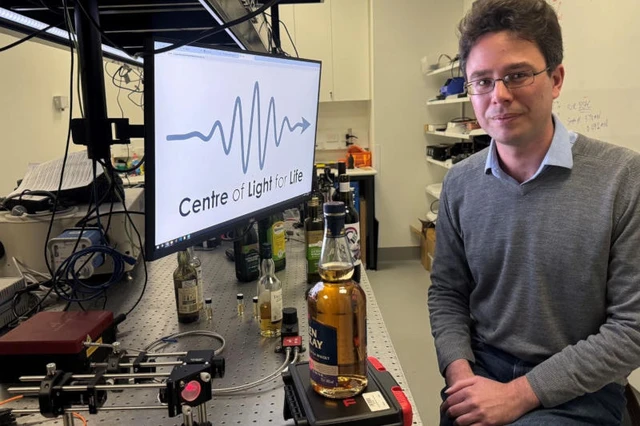
The method's practical efficacy was validated during tests with whisky, where the detector identified methanol concentrations with a sensitivity ten times greater than international safety standards. This level of precision, combined with rapid processing, makes the system orders of magnitude more efficient than traditional laboratory analysis. Verification of a product batch now takes seconds rather than hours, paving the way for express quality control directly within warehouses and customs terminals.
However, the potential of this development extends far beyond the alcohol industry. The principle of molecular scanning through transparent barriers is applicable to any market where compositional purity is critical. This includes the authentication of luxury perfumes, the detection of pesticides in olive oil, or the quality control of pharmaceutical products.
In the long term, such technology could become the gold standard for regulatory bodies, customs agencies, and major distributors. Establishing a transparent supply chain monitoring system would virtually eliminate the entry of dangerous surrogates into the consumer market, transforming high-precision physics into a vital instrument for public safety.
 The Technological Leap in High-Resolution Lithography