For years, additive manufacturing has been constrained by the limitations of layer-by-layer synthesis—a process that inherently throttled both production speed and precision. The transition toward true volumetric fabrication now paves the way for the creation of intricate microsystems in a matter of seconds. A pioneering holographic printing technique enables the "carving" of an object from a photopolymer volume using a single, high-intensity burst of light. This technological leap effectively erases the boundary between digital design and the instantaneous physical manifestation of the microworld.
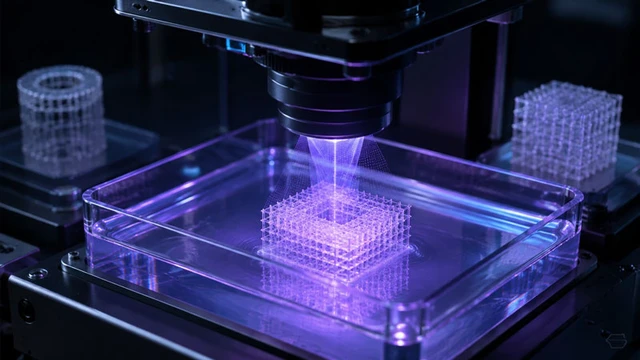
Conventional 3D printing, predicated on the sequential deposition of material, suffers from a fundamental flaw: inherent latency. Even the most advanced stereolithography systems require significant time to move the platform and polymerize each individual layer. Researchers at the University of Utah have proposed a radical alternative: abandoning layer-by-layer construction in favor of holographic light-field synthesis. In this paradigm, an object is not "built" from the bottom up, but is instead created by the simultaneous exposure of the entire volume of photosensitive material.
At the heart of this method lies a specialized phase mask that transforms a standard laser beam into a complex three-dimensional light pattern. Rather than scanning a laser head across coordinates, the system projects the entire geometry of the object instantaneously into a reservoir of photopolymer. However, the implementation of this approach encountered a significant physical barrier: optical aberrations. As light passes through the thickness of a transparent but non-homogeneous polymer, the beams scatter, resulting in a loss of resolution and structural deformation.
To circumvent this issue, a sophisticated compensatory system was developed. Using specialized software, a precision phase mask is generated to pre-correct potential beam deviations based on the properties of the medium. This allows the laser's energy to be directed with surgical precision to the exact points where the solid material must form. The process utilizes SU-8 photopolymer, whose molecular chains cross-link under light exposure, transforming the liquid medium into a monolithic, mechanically robust structure.
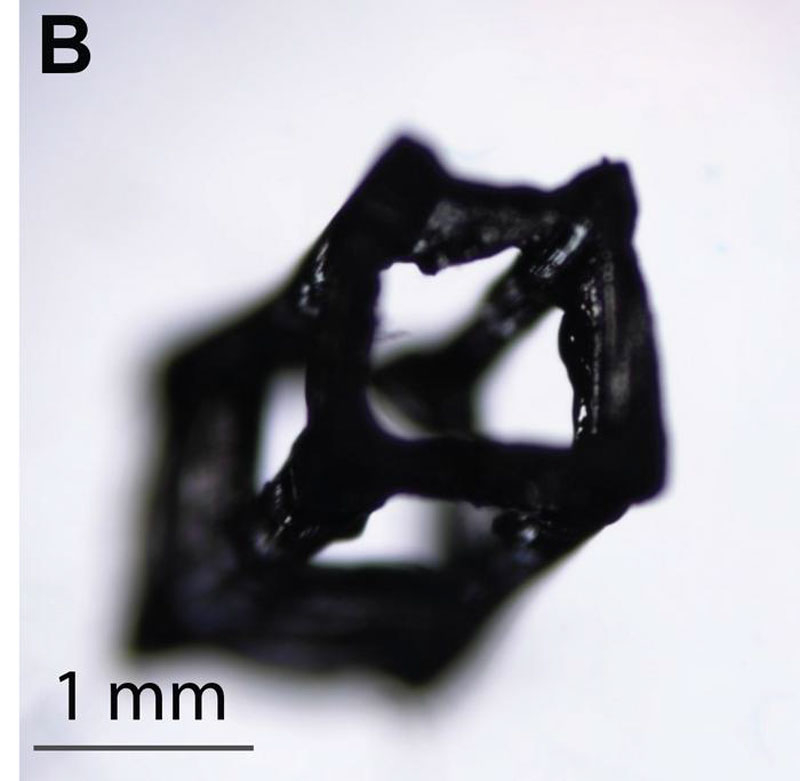
The technical specifications of the resulting prototype are impressive in their efficiency. The system achieves a resolution of 24 $\mu$m per voxel (volumetric pixel), with a filling density reaching $10^5$ voxels per cubic millimeter. This has enabled the creation of components with minimum element sizes of approximately 6 $\mu$m. One of the primary achievements was the successful fabrication of hollow vertical structures—a traditional pain point for many micro-printing methods.
The speed of the process shifts production into an entirely different league: creating millimeter-scale cylinders and cubes takes only 7.5 seconds, with an overall printing speed reaching 1 mm³/s. Furthermore, the resulting objects exhibit high structural integrity. For instance, printed microtubes function fully as capillaries for fluid transport, confirming the practical viability of the method.
The implications of this technology extend far beyond simple rapid prototyping. Holographic printing could become the foundation for the mass production of microfluidic devices used in modern diagnostics and medicine. Moreover, the method opens new avenues for creating components for Micro-Electro-Mechanical Systems (MEMS), complex optical elements, and metamaterials with tailored physical properties that are impossible to achieve through traditional casting or milling.
 The Paradox of Ultra-Fast Charging in Quantum Systems