The challenge of limited energy density remains the fundamental bottleneck obstructing the realization of truly autonomous robotic systems. Traditional battery technology forces engineers into a precarious compromise between payload mass and operational endurance. This dichotomy is being resolved through remote power transfer—a paradigm that allows a craft to be energized in real-time during its mission. Recent breakthroughs in optoelectronics are now paving the way for platforms capable of indefinite aerial persistence, powered by high-precision laser pumping.
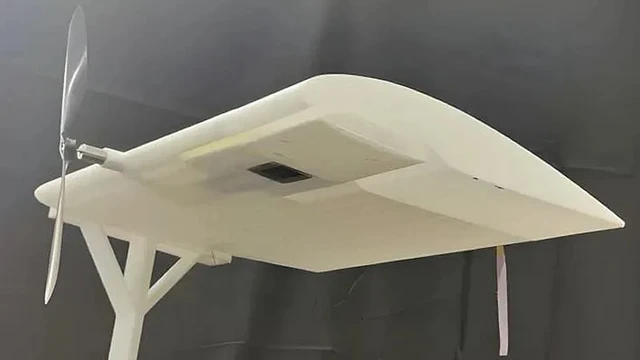
The quest for total autonomy in unmanned systems is shifting its center of gravity away from battery chemistry and toward the realms of quantum physics and materials science. A pivotal breakthrough has emerged in the form of a specialized wing-integrated receiver capable of converting directed laser energy into electrical current mid-flight. This system leverages the green spectrum—specifically wavelengths around 520 nanometers—necessitating a fundamental redesign of traditional photovoltaic cell architecture.
The technological solution employs a tandem architecture that fuses two distinct physical principles of power generation. The primary layer consists of a high-efficiency perovskite cell, precision-engineered for the specific spectral signature of a green laser. Perovskites, prized for their superior charge carrier mobility and tunable bandgaps, allow for maximum photon capture. However, managing such intense radiation flux inevitably generates significant waste heat. To prevent this thermal energy from becoming a liability, a thermoelectric generator is positioned beneath the photocell, utilizing the Seebeck effect to convert heat into additional electrical impulses.
The primary engineering hurdle in this configuration was critical overheating. Under intense irradiation, receiver temperatures climbed to 80–90°C—a threshold fatal to perovskite structures, leading to rapid degradation. To mitigate this, antimony triselenide nanocrystals were integrated into the device matrix. This material possesses exceptionally low thermal conductivity, acting as a thermal barrier that shields the sensitive layer from overheating. Furthermore, the introduction of these nanocrystals facilitated an increase in the grain size of the perovskite itself, minimizing internal defects and significantly enhancing electron transport within the cell.
The design further evolves by synthesizing energy harvesting with aerodynamics. Specialized air-cooling channels were integrated directly into the wing structure; the airflow bypassing the drone during flight functions as an active heat sink for the thermoelectric layer. This synergy not only stabilizes the thermal regime but also reduces overall aerodynamic drag while simultaneously generating additional lift. Laboratory benchmarks have validated the viability of the concept: the receiver maintained a stable motor speed of 7,820 RPM without power fluctuations or signs of thermal failure.
Despite these impressive prototype metrics, transitioning to mass deployment requires solving several fundamental challenges. The primary difficulty lies in developing precision autonomous tracking systems; the laser beam must maintain a lock on the target amidst turbulence and atmospheric interference, such as cloud cover or haze. Moreover, the operation of high-energy beams in open airspace raises significant safety concerns. Rigorous protocols will be essential to eliminate accidental exposure to manned aviation, ground personnel, and local ecosystems.
 Next-Generation Ultra-Lightweight Lens Technology