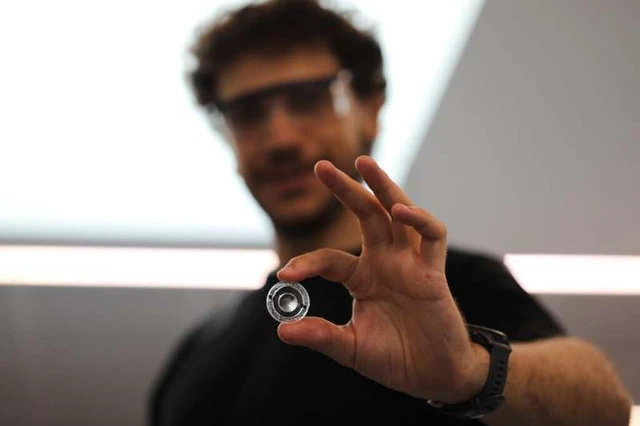
The pursuit of extreme miniaturization in optical systems has long been constrained by the inherent physical limitations of mechanical autofocus. Conventional systems rely on cumbersome actuators and complex lens assemblies, creating a bottleneck for the advancement of wearable electronics and medical sensors. A breakthrough from researchers at Queen Mary University of London proposes a radical pivot toward a biomimetic architecture. The development of an electric-field-controlled "living" lens paves the way for a new generation of devices where optics are fluid, flexible, and seamlessly integrated.
Modern autofocus systems are intricate engineering feats where precision is achieved by shifting glass elements via micro-motors. While effective, this approach remains mechanically cumbersome and space-intensive. An alternative emerges in the form of adaptive optics—a concept capable of altering optical characteristics without moving parts, effectively mimicking the biological function of the human lens.
At the heart of this development is the Dielectric Elastomer Actuator (DEA). Structurally, it consists of a thin polymer membrane held in a pre-tensioned state between two electrodes. When an electric voltage is applied, electrostatic forces compress the membrane, altering the curvature of the lens surface and directly modulating its focal length.
The primary engineering hurdle lay in selecting the electrode material. These components must be simultaneously transparent to avoid obstructing light and elastic enough to deform alongside the polymer without losing conductivity. Reduced graphene oxide (rGO) provided the solution. Thanks to its atomic thickness and unique electronic properties, graphene enabled the creation of electrodes that can be spray-coated directly onto the elastomer surface.
The engineering process required a precise calibration between three critical parameters: electrical conductivity, transparency, and mechanical flexibility. Researchers experimented with rGO layer thicknesses ranging from 50 to 80 nm. They discovered that increasing the material volume significantly reduced sheet resistance but simultaneously caused optical transmittance at a wavelength of 550 nm to plummet from 42% to 17%.
The optimal equilibrium was found in a prototype with approximately 32% transparency. Under an electric field strength of 50 V/µm, this configuration achieved a membrane area change of roughly 10%. By integrating this system with an elastic lens, the team successfully shifted the focal length from 30.1 to 36 mm.
Although the technology remains in the proof-of-concept stage and requires further optimization of electrode transparency, its potential is immense. Eliminating mechanical components and motors paves the way for silent, ultralight focusing systems. This could trigger a paradigm shift in the development of next-generation AR/VR displays, miniature medical endoscopes, and compact cameras whose architecture aligns more closely with the biological eye than the traditional lens.
 Next-Generation Ultra-Lightweight Lens Technology