For years, the evolution of modern solar energy has been defined by a stark trade-off between efficiency and form factor. While traditional silicon provides high stability and conversion efficiency, it remains tethered to heavy glass substrates. Conversely, promising perovskites offer flexibility, albeit at the expense of long-term durability. A team of Italian researchers has now proposed a solution that bridges these two paradigms, transforming brittle crystals into resilient, elastic modules. This technological pivot paves the way for the seamless, large-scale integration of photovoltaics into both architecture and transportation.
For decades, the solar industry has adhered to a paradigm of "square, utilitarian, and dependable." Silicon panels, encased in thick glass, became the industry benchmark for efficiency, yet their weight and rigidity have long limited their application. Meanwhile, the industry looked toward roll-to-roll manufacturing with hope, though such methods were associated exclusively with emerging, yet unstable, materials. A collaboration between the University of Padua and the Institute for Electronics and Magnetism Materials (IMEM-CNR) has upended this perception, proving that even traditional silicon can be flexible.
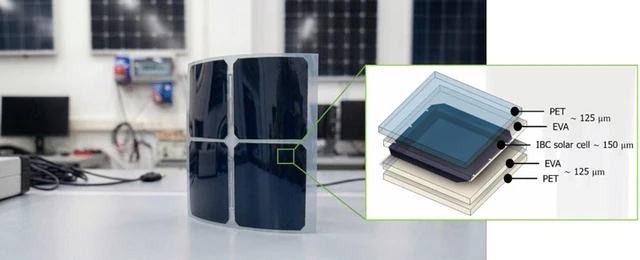
At the heart of this breakthrough is the use of commercial silicon cells featuring Interdigitated Back Contact (IBC) technology. By relocating all electrical contacts to the rear of the cell, the front surface is left unobstructed for maximum light absorption, while simultaneously reducing the risk of mechanical damage during bending. These cells are only about 150 microns thick, making them inherently viable for deformation provided they are given the correct structural support.
In a departure from traditional glass, the Italian researchers employed polyethylene terephthalate (PET). This polymer serves a dual purpose: acting as a protective barrier while radically reducing the module's overall mass. The pivotal achievement was the implementation of a hot roll-lamination method. This is a continuous-flow process where cells are hermetically sealed into the plastic at approximately 390°C, while guide rollers maintain a temperature of 130°C. With a rolling speed of 9 mm/s and a minimum roller gap of 2 mm, a durable yet elastic composite structure is formed.
Efficiency analysis revealed a power loss of approximately 4.4% following lamination. Crucially, this decline is not attributed to the degradation of the silicon itself or the emergence of microcracks. Instead, the cause is optical: additional reflections occur at the air-polymer interface, hindering photons from reaching the active layer. This is a purely technical hurdle that can be easily mitigated through the application of anti-reflective coatings.
The mechanical resilience of the new modules is impressive. A single cell withstood a bending radius of up to 95.4 mm without any signs of structural failure. A more complex 2×2 module retained 93% of its power even at a bending radius of 155 mm. This demonstrates that the polymer cladding effectively distributes mechanical stress, preventing the catastrophic fracture of the brittle crystal.
To verify operational reliability, the prototype underwent an extensive stress test: the module was mounted on a curved surface and exposed to the elements for 672 hours. After nearly a month of testing, efficiency dropped by only 3.88%, confirming the system's high stability. The researchers noted that while lamination does not introduce new defects, it may facilitate the propagation of existing microcracks, underscoring the critical importance of the quality of the initial silicon wafers.
In the near term, the team intends to optimize the assembly process by replacing traditional wire soldering with solder paste technology. This will enable the creation of connections that can melt and reform without inducing internal mechanical stresses—a critical requirement for scalable roll-to-roll production.
Such an approach transforms the solar panel from a cumbersome assembly into a flexible "sheet" that can be integrated directly into automotive bodywork, building facades with complex geometries, or wearable electronics. The shift toward roll-to-roll production of silicon modules could significantly drive down manufacturing costs, making high-efficiency energy harvesting viable for a vast array of applications.
 Starship's Return from the Indian Ocean