The Moon is gradually evolving into a proving ground for analyzing the repercussions of human activity in deep space. A spent stage of a SpaceX Falcon 9 rocket is slated to impact the lunar surface, triggering a unique and uncontrolled scientific experiment. This event will provide researchers with a rare opportunity to analyze ejecta dynamics and the tangible risks posed by orbital debris. The resulting data will serve as a pivotal foundation for safeguarding the infrastructure and security of future lunar habitats.
What appears to be the haphazard descent of space debris is poised to become a significant milestone in planetary science. According to calculations from researchers at the University of Texas at Austin, an upper stage of a Falcon 9 rocket is slated to impact the lunar surface on August 5th. This remnant dates back to the January 15, 2025 launch that delivered the Firefly Blue Ghost-1 and Hakuto-R Mission 2 Resilience landers to the Moon.
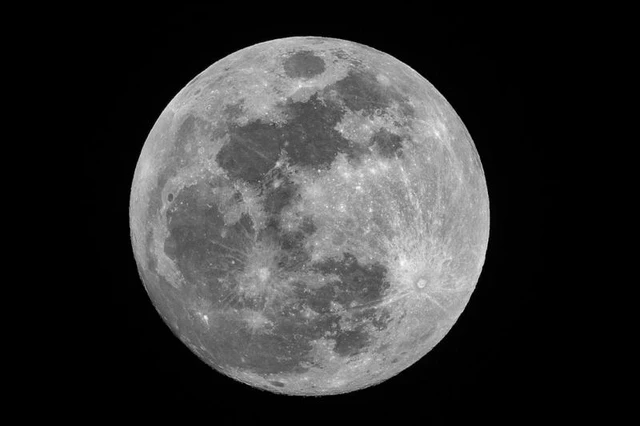
The collision is expected to occur near the Einstein and Bell craters on the Moon's western limb. The impact will likely trigger a massive ejecta plume, lofting dust to altitudes between 75 and 100 kilometers. In the immediate aftermath, the luminosity of this cloud will exceed the dark background of space by several orders of magnitude, potentially making the event observable from Earth via high-sensitivity telescopes.
For the scientific community, the value of this incident extends far beyond a mere visual flash. The collision provides a unique opportunity to calibrate existing ejecta models and test impact localization systems—capabilities critical for future lunar seismic experiments. Furthermore, researchers are keen to analyze particle dispersion dynamics; preliminary data suggests that debris could be propelled up to 1,000 kilometers. This underscores a sobering reality: an accidental strike in one region of the Moon could jeopardize infrastructure or crewed missions in distant sectors.
The physics of the object itself is of particular interest. Unlike asteroids or comets—typically dense rocky or icy bodies—the Falcon 9 stage is a hollow metallic cylinder. This distinct geometry may produce radically different ejecta patterns upon impact, allowing scientists to refine models regarding how artificial objects interact with planetary bodies.
To ensure maximum analytical precision, the Lunar Reconnaissance Orbiter (LRO) has been deployed for detailed observation. The orbiter will perform flyovers of the projected crash site one week before and after the event, capturing "before-and-after" snapshots to assess crater dimensions and dust deposition patterns. In a striking turn of events, a piece of orbital debris is being transformed into a sophisticated tool for lunar geology and a blueprint for securing humanity's future expansion into deep space.
 Tesla Roadster: A New Wave of Ambition