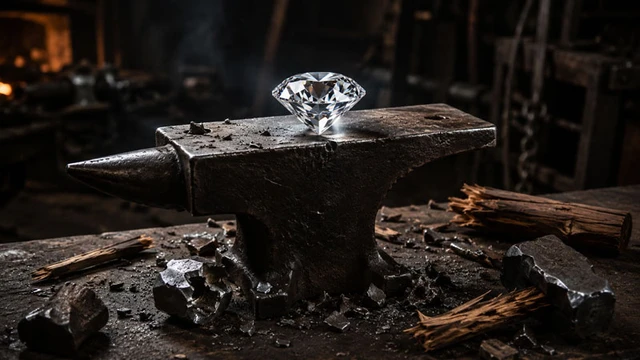
The quest for the ideal material has long been stalled by a fundamental trade-off: the tension between extreme hardness and fracture toughness. Diamond, while the absolute benchmark of hardness, remains catastrophically brittle under impact loads due to its tendency to cleave along specific crystallographic planes. However, a recent technological breakthrough in the synthesis of carbon structures is finally dismantling this barrier. By integrating nanotubes into the crystalline lattice, we are paving the way for materials that are virtually impervious to mechanical failure.
In materials science, a long-standing challenge persists: the inverse relationship between hardness and toughness. Diamond serves as the quintessential example of this paradox; despite its unparalleled resistance to scratching, it is prone to catastrophic cleavage under sudden impact or bending stress. Researchers from the Institute of Physics of the Chinese Academy of Sciences and Beihang University have sought to resolve this conflict by engineering a sophisticated composite that integrates a traditional polycrystalline diamond matrix with a three-dimensional network of multi-walled carbon nanotubes (MWCNTs).
The fabrication process for such a material requires conditions akin to those found within Earth's mantle. The synthesis utilized diamond powder with grain sizes ranging from 0.8 to 1.3 $\mu$m and nanotubes with diameters of just 10–20 nm. The critical phase involved sintering in a press under a colossal pressure of 15 GPa and temperatures reaching approximately 2000 °C. This process yielded compact cylindrical samples where the nanotubes, despite occupying only 0.35% of the total volume, established a continuous spatial framework permeating the entire material.
The key to this success lies in the chemical nature of the interaction between the components. Under peak pressure, a portion of the carbon nanotubes underwent a phase transition, partially transforming into diamond. Consequently, the reinforcing fibers did not merely fill the voids between crystals mechanically; they became covalently "stitched" into the overall architecture. The result is a hybrid material: extreme hardness is maintained through the robust bonds between diamond grains, while structural integrity is ensured by the flexible and resilient nanotube network.
From the perspective of fracture physics, this modification fundamentally alters the material's behavior under critical loads. In standard single-crystal diamond, a crack propagates in a straight line, leading to instantaneous failure. In this new composite, however, the crack path becomes stochastic; it is repeatedly deflected and branched, forced to overcome the resistance of nanotubes that effectively "bridge" the separating sections of the matrix. This forces the system to dissipate significantly more energy for every millimeter of damage progression.
The empirical results are striking: the Vickers hardness remains consistent with single-crystal diamond (91.6 GPa), yet fracture toughness has surged to 31.9–36.4 $\text{MPa}\cdot\text{m}^{1/2}$. These figures are five to six times higher than those of standard diamond, placing this new material above many tungsten alloys in terms of crack resistance.
Such synthesis opens new horizons for high-precision instrumentation and the aerospace sector. The ability to engineer tools that simultaneously possess extreme wear resistance and impact strength will allow for a radical modernization of cutting tools and superhard ceramics operating under severe pressure and dynamic loading conditions.
 Next-Generation Ultra-Lightweight Lens Technology