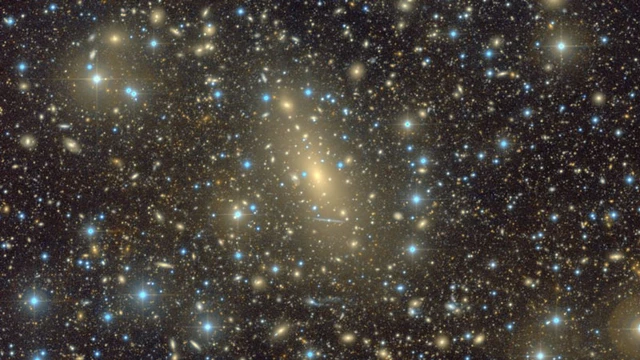
Modern astronomy has transitioned from an era of isolated observations into an age of comprehensive digital cartography. The creation of the most detailed color map of the universe was made possible through the synthesis of data from several world-leading observatories, powered by high-performance supercomputing. Spanning three-quarters of the celestial sphere, this massive dataset transforms the apparent chaos of the night sky into a structured catalog designed for the rigorous analysis of dark energy. What we have here is not merely an image, but a foundational instrument with the potential to rewrite the very laws of cosmology.
The sheer scale of the new celestial map is breathtaking: 5.6 trillion pixels and nearly 4 billion identified objects. This digital atlas captures not only brilliant stars and distant galaxies but also entities that remained shrouded behind dense veils of cosmic dust for decades, thanks to the integration of visible and near-infrared spectrums. Such granular detail transforms the map into a comprehensive search environment for detecting the rarest cosmic phenomena—from supernovae to gravitational lenses warping the light of distant worlds.
At the heart of this achievement lies five years of rigorous work by the DESI (Dark Energy Spectroscopic Instrument) collaboration, whose primary mission is to unravel the nature of dark energy. However, the map is the result of a complex synthesis of data from multiple sources. It integrates survey results from DECaLS at the Cerro Tololo observatory in Chile, MzLS from Kitt Peak, and BASS (Beijing-Arizona Sky Survey), all augmented by years of infrared expertise from NASA's WISE telescope.
Assembling this puzzle proved to be a formidable engineering challenge. The team had to merge over 263,000 individual exposures collected across thousands of observation nights. The primary difficulty lay in normalizing every frame to a single standard: discrepancies in sensor sensitivity, the unique optical characteristics of different telescopes, and the volatile state of Earth's atmosphere required meticulous calibration. More than 160 scientists participated in this process, with the final stage of data preparation overseen by a lean group of twenty specialists.
Processing such a colossal volume of information required the computational power of the Perlmutter supercomputer, housed at the National Energy Research Scientific Computing Center (NERSC) at Berkeley Lab. The project's tech stack included a full year of developing specialized image-stitching software followed by two months of continuous high-performance computing.
The result is not merely a static "photograph" of the sky, but a dynamic database. For every light source, precise coordinates and brightness levels across several spectral bands have been recorded. This creates an ideal foundation for training artificial intelligence systems, which will soon be tasked with analyzing petabyte-scale archives from new astronomical surveys.
From a technical standpoint, this survey serves as the "input catalog" for the DESI spectroscopic instrument. While a two-dimensional map provides an understanding of where objects are located and their luminosity, spectroscopy allows researchers to determine the redshift of light. This effectively adds a third coordinate—distance—to the flat image, transforming the map into a full 3D model of the large-scale structure of the Universe. Such precision enables scientists to track the rate of cosmic expansion and investigate the properties of dark energy.
The efficiency of the DESI instruments was so high that original plans for the catalog's volume had to be revised and expanded. Looking ahead, this dataset will serve as a gold-standard benchmark for comparison with future observations from the Rubin Observatory and the Roman Space Telescope.
The scientific impact of the project is already tangible, with over 1,800 papers published based on the available data. Furthermore, preliminary results are leading scientists to question the constancy of dark energy across different stages of the Universe's evolution. Should this hypothesis be confirmed, our current understanding of the physics of the cosmos will require a radical revision. The next major DESI data release is expected in the first half of 2027.
 Next-Generation Ultra-Lightweight Lens Technology