The contemporary race to the Moon and Mars hinges on the reliability of the most powerful launch system in human history. SpaceX is finalizing preparations for Starship's thirteenth test flight—a mission poised to be a pivotal milestone in validating the spacecraft's latest configuration. Recent static fire tests of the Super Heavy booster confirm that the vehicle is engineered to withstand the immense structural loads encountered during orbital ascent. This launch is designed not merely to replicate past successes, but to systematically rectify the critical shortcomings of previous missions.
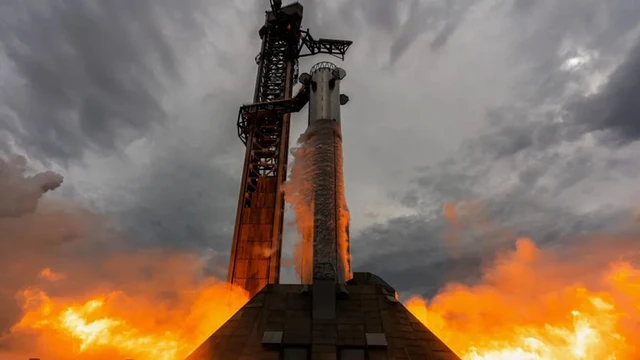
At Starbase in Texas, one of the most critical phases of preparation for the upcoming launch has concluded. The Super Heavy booster in its V3 configuration (prototype Booster 20) has successfully completed a full-scale static fire test. For 25 seconds, all 33 Raptor 3 engines fired in perfect synchronicity, generating the colossal thrust required to propel the multi-ton structure beyond the dense layers of the atmosphere during an actual flight.
This burn was significantly more prolonged than standard short-duration ignition checks. While the booster was firmly secured to the stand by the Mechazilla tower's mechanical clamps, engineers analyzed the behavior of the fuel system, the performance of the automation, and the stability of the ground infrastructure under sustained load.
The V3 iteration represents a major evolutionary leap. At the heart of the updated booster are the Raptor 3 engines, powered by sub-cooled liquid methane and oxygen. Compared to its predecessors, this version features a redesigned propulsion system with an optimized ignition algorithm, increased fuel tank capacity, and lightweight avionics. However, the most pivotal technological innovation is the equipment for cryogenic fuel transfer between the upper stage tanks. This system is the cornerstone of the orbital refueling architecture, without which delivering a 100-ton payload to low Earth orbit and subsequent transit to the Moon would be physically impossible.
For the upcoming mission, Booster 20 will be paired with Ship 40. The upper stage already completed its own testing in early July, confirming the operational readiness of all six engines. The thirteenth mission carries particular weight, as it is intended to address the ambiguous outcomes of the May 22 flight.
Previous experience was both sobering and instructive. During the twelfth launch, Booster 19 failed to execute its planned descent maneuvers upon return, resulting in an unsuccessful splashdown. Ship 39, while achieving a suborbital trajectory, encountered an engine anomaly that forced SpaceX to abandon the vacuum restart attempt. These incidents drew the attention of the Federal Aviation Administration (FAA), which classified the events as off-nominal and mandated a detailed investigation.
The objective of the thirteenth flight is a flawless execution of the previous mission's primary goals, incorporating the necessary fixes. Special emphasis will be placed on the controlled return of both stages. Ship 40 is expected to enter the atmosphere in a belly-flop orientation, relying on its ceramic heat tile shielding, before performing its flip maneuver and executing a soft splashdown in the Indian Ocean. A splashdown is also planned for the Super Heavy; a full capture by the tower mechanism remains a goal for subsequent, later tests.
According to FAA operational schedules, the primary launch window opens on July 15, with a backup window the following day. While the final decision depends on the clearance of all regulatory hurdles, the strategic importance of Starship to NASA's lunar program makes significant delays unlikely. Once technical readiness is fully certified, the V3 system will take to the skies to prove its viability.
 Space Debris Poses a Growing Threat to Low Earth Orbit Constellations