The death of a star typically signals a final sentence for its orbiting companions. However, the discovery of exoplanet WD 1856 b, orbiting a white dwarf, challenges conventional wisdom regarding the inevitable demise of planetary systems. Leveraging the James Webb Space Telescope, researchers have peered into the atmosphere of this giant, uncovering unexpected chemical signatures. This finding compels a reevaluation of the mechanisms governing celestial migration under extreme conditions. It represents the first documented instance of a planet surviving the collapse of its parent star.
In the realm of classical astrophysics, the life cycle of a star concludes in a dramatic fashion. When a massive luminary exhausts its hydrogen reserves, it expands into a red giant, consuming all nearby planets in its path. The subsequent collapse into a white dwarf—a dense, searing remnant roughly the size of Earth—typically leaves behind nothing but a void or drifting clouds of cosmic dust. This is why the 2020 discovery of the exoplanet WD 1856 b became a genuine scientific sensation: the object existed exactly where, according to every established model, it should have been annihilated billions of years ago.
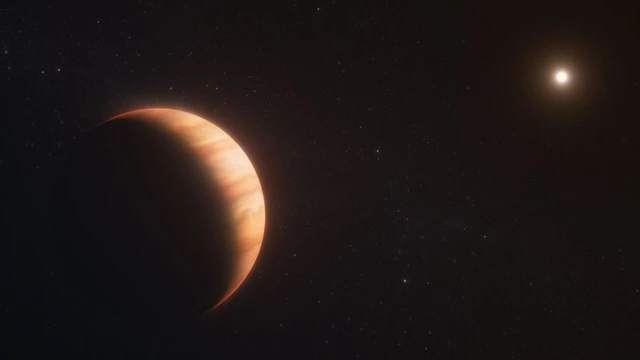
Located 82 light-years away, the system presents a paradox of proportions. The star, WD 1856+534, possesses approximately half the mass of our Sun, yet its physical dimensions are comparable to those of Earth. Orbiting this compact stellar remnant is a gas giant with a radius nearly equal to Jupiter's and a mass that recent estimates place as high as 10.9 Jupiter masses.
Observing this system required scientists to abandon conventional methodologies. In a standard transit scenario, a planet crosses the stellar disk, causing a sharp dip in brightness. However, in the case of WD 1856 b, the planet is so massive relative to its host star that its transit lasts only eight minutes, during which the star's brightness plummets by half. This anomaly forced researchers to recalibrate their mathematical transit models to correctly interpret the data.
The key to unlocking the system's history lay in the spectroscopic analysis of the atmosphere conducted by the James Webb Space Telescope (JWST). Hydrocarbons were detected within the planet's gaseous envelope, with methane emerging as the dominant component at a concentration of approximately 7%. For comparison, methane accounts for only 0.3% of Jupiter's atmosphere. Such a high concentration poses a significant challenge to existing thermal evolution models for gas giants.
This specific chemical composition and temperature profile allowed scientists to weigh two divergent hypotheses. The first suggested that the planet had somehow miraculously survived in its current orbit during the star's red giant phase. However, the physics of the process renders this nearly impossible: the expanding stellar envelope would have either stripped the planet's atmosphere entirely or swallowed the world whole.
The second, more plausible scenario points to a complex gravitational choreography. It is likely that WD 1856 b originally occupied a distant, safe orbit. The presence of other remote companions in the system may have triggered a gravitational resonance, flinging the planet into a highly eccentric, elliptical trajectory. Billions of years after the star's death, the planet began an inward spiral, drawing closer to the white dwarf.
As the planet approached, tidal forces took hold. These forces not only heated the planet's interior but gradually "circularized" its orbit, transforming it into the nearly perfect circle observed today. Currently, WD 1856 b exists in extreme proximity to its star—just 0.02 astronomical units (AU)—completing a full orbit every 1.4 days.
This case proves that planetary survival following the death of a host star is possible, provided the planet possesses a sufficient orbital buffer and undergoes subsequent migration. The discovery of WD 1856 b opens an entirely new frontier in exoplanetology. If such scenarios are typical, it implies that millions of white dwarfs across our galaxy may be orbited by hidden worlds that we simply haven't been looking for.
 Navigating via Earth's Gravitational Anomalies