Mars has long been perceived as a dormant, frozen world, yet recent data reveal a planet defined by profound internal contradictions. Research points to a staggering thermal disparity between the planet's northern and southern hemispheres—an anomaly that challenges conventional assumptions regarding the spherical symmetry of celestial bodies and hints at cataclysmic events in the distant past. Deciphering this imbalance provides a critical new lens through which to examine the history of water, volcanic activity, and the potential habitability of the Red Planet.
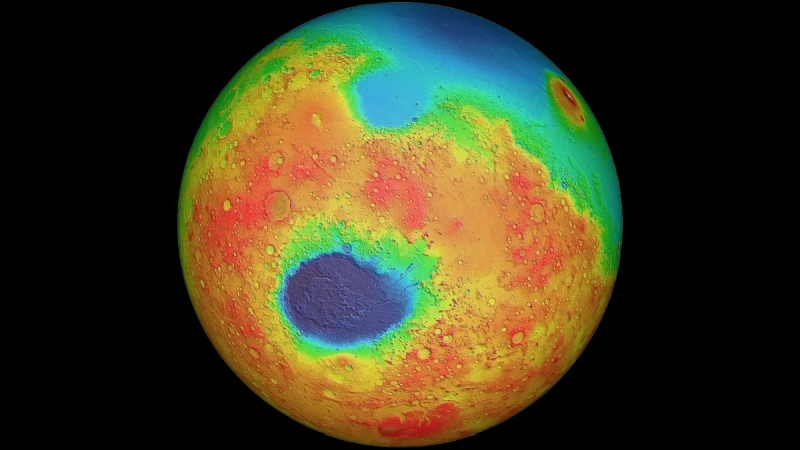
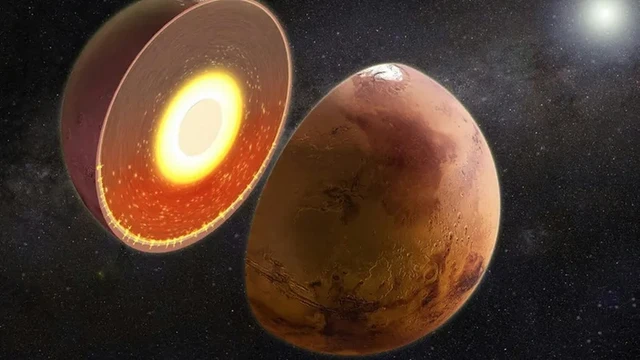
Contemporary understanding of Mars' internal architecture increasingly suggests that the planet is a union of two fundamentally different worlds. The deep layers of the southern hemisphere are significantly hotter than those of the north, with temperature differentials reaching 400°C. This thermal gradient correlates directly with the visual and geological dichotomy of the surface: the flat northern plains stand in stark contrast to the rugged, rocky highlands of the south.
To detect this anomaly, researchers employed a method known as "tidal tomography." This technique relies on the analysis of minute fluctuations in the orbital velocities of the Mars Global Surveyor, Mars Odyssey, and Mars Reconnaissance Orbiter spacecraft. Any deviation from perfect spherical symmetry in the planet's internal mass distribution creates variations in the gravitational field, which are captured by the probes' sensors. By accounting for Mars' elliptical orbit and the shifting influence of solar gravity, researchers were able to reconstruct the planet's internal structure, revealing that the mantle beneath the southern hemisphere is substantially hotter than its northern counterpart.
Such internal heterogeneity explains many of the planet's topographical anomalies. The crust in the south is, on average, 25 kilometers thicker than in the north and is characterized by dense crater clusters and high plateaus. Meanwhile, the northern lowlands—which may have once served as the bed of a global ocean—point to entirely different formative processes. This thermal imbalance directly influenced the planet's hydrology, determining where basins capable of retaining water could form.
Seismological data has further validated these findings. Data from the InSight mission demonstrated that seismic waves dissipate more rapidly in the south, a direct consequence of the higher temperature of the material. Furthermore, this thermal regime sheds light on the mystery of Mars' vanished magnetic field. Approximately four billion years ago, the planet possessed global magnetism, which eventually decayed. It is hypothesized that upwelling heat from the southern mantle heated the crust beyond the "Curie temperature"—the critical threshold at which materials lose their magnetic properties. This process resulted in the specific remanent magnetization found in iron-bearing minerals observed today.
What caused this profound division? The prevailing hypothesis points to a cataclysmic cosmic collision occurring more than four billion years ago. According to this theory, the northern lowlands are the result of a single colossal impact that transformed an entire hemisphere into a giant crater. The collision triggered a massive release of internal energy, which paradoxically accelerated the cooling of the northern mantle relative to the south. An alternative perspective suggests that the massive crust of the southern hemisphere may have acted as a thermal insulating "cap," trapping heat within the mantle and preventing it from dissipating efficiently into space.
Tidal tomography is opening new frontiers for planetary science. Its potential extends far beyond Mars and could be applied to the study of Mercury or the largest moons of Jupiter. As gravimetric datasets accumulate, humanity will gain the ability to create detailed three-dimensional maps of the internal structures of other worlds, allowing us to reconstruct the precise evolutionary timeline of their formation.
 Redefining the Scale of Deep Space Exploration