Global aviation's transition to sustainable energy sources has emerged as one of the defining technological hurdles of the decade. While hydrogen fuel cells promise a zero-carbon footprint, their practical implementation has hit a fundamental physical wall. The challenge of efficient thermal management is forcing engineers to rethink the very architecture and aesthetics of aircraft design. The "One" business jet project serves as a compelling case study in how the battle against overheating is sculpting a new aesthetic for the "green" skies.
The blueprint for modern zero-emission aviation centers on low-temperature Proton Exchange Membrane (PEM) fuel cells. In these systems, hydrogen combines with oxygen extracted from ambient air; this electrochemical process generates electrical current and pure water. On the surface, the scheme appears ideal, yet in practice, it collides with the uncompromising laws of thermodynamics.
While fuel cells boast efficiencies far superior to traditional internal combustion engines, a substantial portion of energy is still dissipated as heat. In a conventional jet engine, this issue is resolved naturally: the bulk of excess thermal energy is expelled from the aircraft via scorching exhaust gases. In a hydrogen-electric system, however, there is no "exhaust" in the traditional sense, meaning heat accumulates within the system.
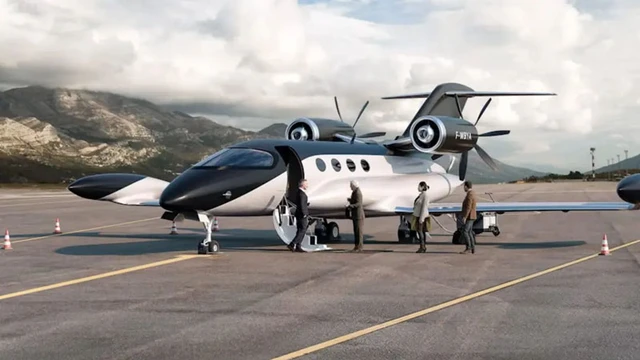
For the "One" business jet—a six-passenger aircraft with a 1,500 km range—this thermal challenge has reached a critical threshold. With a rated power output of approximately 1 MW, engineers must manage a comparable volume of thermal energy. This necessitates the development of massive, high-efficiency heat exchangers capable of maintaining an intensive airflow.
This creates a fundamental engineering paradox: expanding cooling intakes inevitably increases aerodynamic drag. Every additional centimeter of intake reduces overall flight efficiency and curtails range, forcing developers into a precarious trade-off between thermal stability and operational autonomy. The situation is further complicated by high-altitude performance; as air density drops, delivering oxygen to the PEM cells becomes more difficult, requiring powerful compressors that themselves become additional sources of heat.
Alongside these thermal hurdles, designers are tackling the challenge of energy storage. For the One project, a conscious decision was made to utilize gaseous hydrogen stored in tanks at 700 atmospheres, rather than the more energy-dense but volatile liquid hydrogen. While this approach significantly simplifies certification and eases the requirements for airport ground infrastructure, it imposes severe constraints on the aircraft's geometry.
Gaseous hydrogen necessitates bulky storage tanks that cannot be integrated into a conventional fuselage without sacrificing payload capacity. Consequently, the tanks—along with the two electric propeller engines—have been moved outside the main fuselage and positioned above the wing. This architectural pivot fundamentally alters the traditional airliner silhouette, transforming the aircraft into a hybrid of pure functionality and physical necessity.
Currently, the project has successfully cleared the Preliminary Design Review (PDR) and transitioned into the detailed design phase. The primary objective now is to navigate the rigorous certification standards of EASA and the FAA, which will serve as the ultimate litmus test for the viability of this new concept in hydrogen-powered flight.
 The Energy Efficiency Ceiling of Modern Electric Vehicles