The universe is predominantly composed of an invisible substance that dictates the structural architecture of galaxies and the dynamics of stellar systems. For decades, fundamental physics has sought to unravel the nature of dark matter, evolving from theoretical field concepts toward the hunt for specific elementary particles. The key to unlocking this mystery may lie in a distinct gamma-ray burst—a signature produced by the annihilation of these particles. Recent analyses of data from the Fermi Space Telescope offer some of the most compelling indirect evidence yet for the existence of this elusive matter.
Modern cosmology has long operated on the premise that dark matter consists of weakly interacting particles. However, the precise nature of these particles remains one of science's most enduring mysteries. The most influential hypothesis centers on WIMPs—Weakly Interacting Massive Particles. Because these particles barely interact with ordinary matter, detecting them through traditional means is nearly impossible. The only reliable way to "see" them is to capture the indirect signatures of their interactions—specifically, the process of annihilation, which produces a powerful and distinct emission in the gamma-ray spectrum.
Astrophysicists from the Chinese Academy of Sciences have conducted a comprehensive retrospective analysis of archival data from the Fermi Gamma-ray Space Telescope. Their study leveraged a massive dataset spanning 15.5 years, collected by the Fermi-LAT instrument. The researchers were hunting for so-called "gamma-ray lines"—narrow spectral spikes that stand out sharply against the background noise. Unlike most astrophysical sources, which generate a broad spectrum of radiation, WIMP annihilation should leave a clear, almost monochromatic "fingerprint."
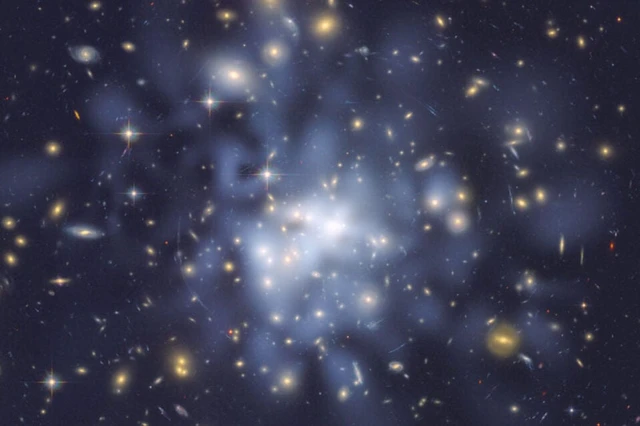
The team focused their analysis on 13 massive galaxy clusters located in our relative cosmic neighborhood. The most pronounced signals were detected in the directions of the Virgo, Fornax, and Ophiuchus clusters. The analysis revealed an unusually narrow emission line with an energy of approximately 43.2 GeV. From the perspective of theoretical physics, this energy level correlates directly with the mass of hypothetical WIMPs, turning this signal into potential evidence of their existence.
However, high-energy physics demands a rigorous standard of verification. For a signal to be recognized as a formal discovery, its statistical significance must reach the 5$\sigma$ (five-sigma) threshold, which virtually eliminates the possibility of a random fluke. In this instance, the researchers recorded a value of 4.3$\sigma$ for the three most active clusters and 3.7$\sigma$ for the entire sample. While highly suggestive, these figures fall short of the threshold required for an official announcement of discovery.
At this stage, the signal is interpreted not as a definitive detection of dark matter, but as an anomaly that cannot be explained by standard astrophysical models. This presents the scientific community with a significant challenge: we are either dealing with a more complex model of dark matter than previously assumed, or there exists a previously unknown class of astrophysical objects capable of mimicking the WIMP signature. In either case, the detected line demands independent verification and new data that could finally expand the frontiers of our understanding of the universe.
 The End of the Falcon 9 Era