The global shift toward an AI-driven economy is no longer a theoretical exercise; it has materialized into tangible financial metrics. At the heart of this evolution lies TSMC—virtually the sole entity capable of delivering the requisite computational power at an industrial scale. The company’s recent financial disclosures reveal more than mere profit growth; they signal a fundamental shift in the architecture of semiconductor demand. Success is no longer measured by wafer throughput, but by transistor density and the sheer efficiency of cutting-edge fabrication nodes.
TSMC's second-quarter financial results serve as a stark testament to how deeply AI has permeated the fabric of the modern semiconductor industry. The company reported a record net profit of $22 billion, representing a staggering 77.4% year-over-year increase, with total revenue reaching $40.2 billion. Most notable is the trajectory of its margins: operating profit climbed from 49.6% to 60.3%, while the gross margin rose to 67.7%.
This surge in profitability stands in stark contrast to physical production volumes. Wafer shipments increased by only 16.6%, reaching 4.4 million units. This suggests a strategic pivot: TSMC is no longer chasing sheer quantitative growth, but is instead focusing on qualitative expansion—transitioning toward maximum-margin products. Consequently, profit is scaling significantly faster than either revenue or production volume.
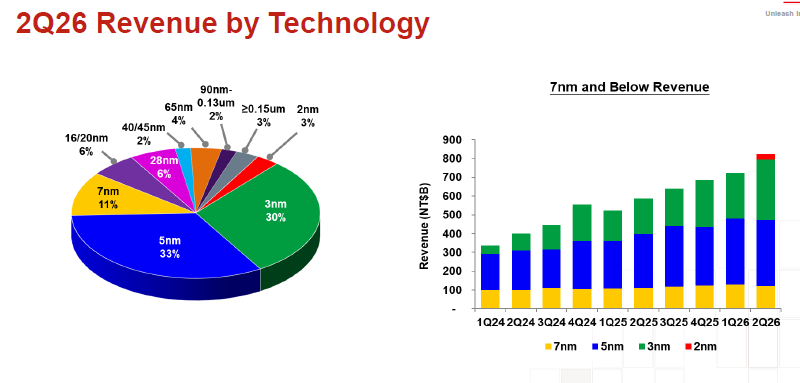
The primary catalyst for this shift has been the adoption of advanced process nodes (7nm and below), which now account for 77% of the company's total revenue. The 3nm node has emerged as the clear frontrunner, with its share of revenue climbing to 30%, maintaining a steady upward trajectory compared to last year. Meanwhile, the 5nm process is seeing a gradual decline, with its share slipping from 36% to 33%. While the 2nm node is still in the early stages of deployment—contributing less than 3% to revenue—it represents the next critical frontier in the battle for computational efficiency.
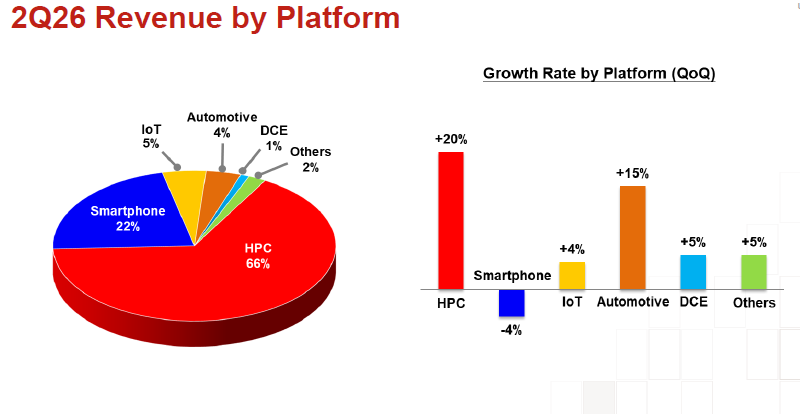
A structural shift is also evident across market segments. High-Performance Computing (HPC), encompassing CPUs and specialized AI accelerators, now generates 66% of TSMC's revenue. This sector is experiencing explosive growth, while the traditional engine of growth—the smartphone market—is losing ground. The mobile segment's share has contracted from 27% to 22%, signaling a saturation of the consumer electronics market and a decisive industry pivot toward server capacity and cloud computing.
The geographical distribution of revenue reflects current geopolitical and technological realities. North America, home to the primary architects of AI silicon—from NVIDIA to Apple and AMD—now provides 78% of TSMC's revenue. Conversely, China's influence is visibly waning, with its share dropping from 9% to 6%. The Asia-Pacific region, Japan, and Europe maintain stable but secondary positions within the revenue structure.
To sustain this momentum, TSMC continues to commit colossal sums to capacity expansion. Capital expenditures for the second quarter alone totaled $15.7 billion, bringing year-to-date investments to $26.8 billion. The strategic roadmap envisions a balanced expenditure profile aimed at reaching approximately $62 billion in capital investments by the end of 2026. This aggressive expansion has given management the confidence to upwardly revise its revenue growth forecast for the current year, raising it from 30% to 40%.
 Intel’s Strategic Play for Advanced Packaging Supremacy