High-energy neutrinos remain among the most elusive and enigmatic messengers from the depths of the cosmos. For years, the prevailing consensus held that only the extreme gravitational wells of supermassive black holes possessed the power to generate particles of such colossal energy. However, a recent discovery has compelled astrophysicists to rethink this established paradigm. The detection of an unexpected neutrino source in a distant galaxy demonstrates that the mechanisms driving cosmic acceleration are far more diverse than previously imagined.
Neutrinos are often dubbed "ghost particles" due to their uncanny ability to traverse virtually any medium with almost zero interaction. Unlike charged cosmic rays, which are deflected by magnetic fields, neutrinos travel in straight lines, preserving a precise map of their point of origin. Yet, this same transparency makes them notoriously difficult to detect; scientists must rely on indirect signatures—secondary particles produced during the rare instances when a neutrino collides with an atomic nucleus within massive detectors.
In modern astrophysics, a general consensus has emerged: if an ultra-high-energy neutrino is detected, its source is likely an Active Galactic Nucleus (AGN). At the heart of these systems, supermassive black holes consume vast quantities of matter, generating powerful jets and extreme conditions ideal for particle acceleration. This was the exact scenario researchers expected when analyzing event IC 210922A, recorded on September 22, 2021, by the IceCube Observatory, embedded deep within the Antarctic ice.
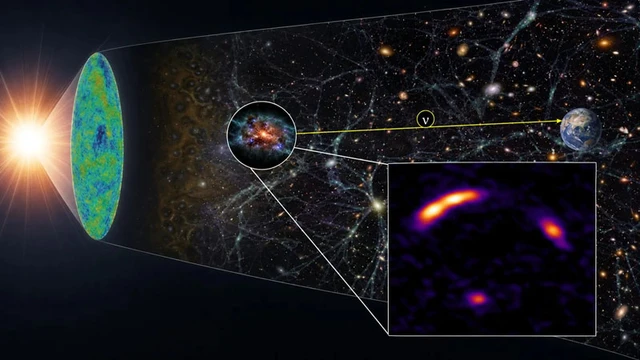
However, the reality proved far more intriguing. The search led scientists to an object designated JCMT0402−0424, nicknamed the "Shadow Blaster." Located approximately 11 billion light-years away, this galaxy bore little resemblance to a typical AGN. No evidence of a supermassive black hole's activity was found at its core; instead, researchers detected an anomalously high rate of star formation.
The challenge lay in the fact that the "Shadow Blaster" is almost entirely shrouded by dense clouds of cosmic dust, rendering it invisible in the optical spectrum. To pierce this veil, astronomers leveraged the capabilities of the ALMA radio telescope. The investigation was further aided by a rare astronomical fluke: gravitational lensing. A massive elliptical galaxy, positioned directly between Earth and the target, acted as a natural lens, bending and amplifying the light from the distant system. This provided researchers with four distorted yet detailed images of the "Shadow Blaster," enabling a profound analysis.
Comprehensive studies across X-ray and gamma-ray spectra, combined with spectral analysis of carbon monoxide (CO) and neutral carbon lines, ultimately debunked the black hole hypothesis. The data revealed a compact region, spanning only 1,500 light-years, characterized by an explosive starburst. Within this confined space, hundreds of solar masses of matter are converted into new stars every year.
From the perspective of high-energy physics, such an environment serves as an ideal natural accelerator. Under conditions of extreme gas density, high-energy particles undergo repeated collisions. These interactions generate short-lived particles whose decay results in the emission of gamma rays and the very neutrinos that, billions of years later, reached the detectors in Antarctica.
While the link between event IC 210922A and the "Shadow Blaster" galaxy is not definitive proof, the probability of a random coincidence is estimated at less than 1%. This discovery is fundamental to our understanding of the universe's architecture. If such compact, dusty galaxies are ubiquitous, they could account for a significant portion of the overall neutrino background—estimated between 15% and 20%. Consequently, a new and unexpected player has entered the arena of cosmic radiation sources, expanding our understanding of where and how the most powerful energy in the cosmos is forged.
 The End of the Falcon 9 Era