For decades, the exploration of alien worlds has been stifled by a single, fundamental bottleneck: the sluggish pace and limited mobility of autonomous platforms. Today's Mars rovers are constrained by an extreme need for caution, transforming every single kilometer of traversal into an arduous, multi-day operation. Enter ERNEST, a new prototype from JPL that promises to disrupt this paradigm by introducing a fundamentally different philosophy of mobility. By fusing active suspension systems with deep learning, the vehicle does more than simply navigate; it dynamically adapts to the terrain in real time.
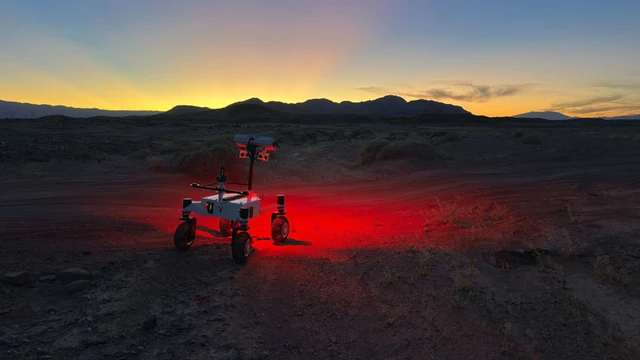
The Colorado Desert of California recently served as the proving ground for ERNEST (Exploration Rover for Navigating Extreme Sloped Terrain), an experimental rover poised to become the technological cornerstone for the next generation of lunar and Martian missions. Developed by the Jet Propulsion Laboratory (JPL), this compact platform—measuring approximately 1.2 meters in length—was engineered not merely as another research vehicle, but as a sophisticated testbed for systems designed to exponentially increase autonomous traversal distances.
The field test results are compelling: over a 37-hour window, the rover covered roughly 26 kilometers with minimal operator intervention. In specific sectors, ERNEST reached speeds of up to 1 km/h, nearly an order of magnitude faster than the pace of veterans like Curiosity and Perseverance. In the context of interplanetary missions, such a leap in velocity represents a vast expansion of the operational envelope, granting access to scientific targets previously deemed unreachable due to stringent time and energy constraints.
The core technological breakthrough of ERNEST lies in its transition from a passive to an active suspension system. Every previous Mars rover, beginning with the pioneering Sojourner, relied on traditional linkages and joints that distributed loads across the wheels according to a fixed mechanical logic. ERNEST, by contrast, can dynamically redistribute its weight and alter its chassis configuration in real-time based on the complexity of the terrain.
This versatility allows the platform to toggle between several modes of locomotion. Beyond standard traversal, the rover is capable of "wheel-stepping" to scale steep ledges and rocky obstacles, or "crab-walking"—a lateral translation enabled by four independently steered mesh wheels. To optimize power consumption, engineers integrated a coupling mechanism that allows the suspension to revert to a passive state when navigating flat terrain.
Particular attention was paid to illumination dynamics. Testing was conducted across a full diurnal cycle, from dawn and the harsh glare of midday to deep twilight and total darkness. This is critical for future missions to the lunar poles, where the low angle of the Sun creates extreme, high-contrast shadows. In such environments, traditional computer vision systems often falter, misidentifying shadows as craters or failing to detect jagged rocks.
The intelligence driving ERNEST is rooted in Reinforcement Learning (RL). The development process mirrored the creation of a "digital twin": JPL constructed a high-fidelity virtual model of the rover, integrating precise data on the physical interaction between the wheels and various soil types. By running thousands of hours of simulations on high-performance computing clusters, the algorithms were able to "learn" optimal behaviors in a virtual environment within a matter of days.
The final stage of verification took place in the "Mars Yard"—a specialized facility that simulates the Martian landscape, complete with sandy ridges, boulder fields, and steep inclines. The developers' next objective is to integrate the active suspension control with a global path planner. The ultimate goal is for the rover to autonomously assess the landscape and determine the most efficient course of action: whether to expend energy "stepping" over an obstacle or to opt for a more efficient detour.
 A New Memory Paradigm for AI Accelerators