The AI explosion has elevated high-performance memory to one of the most critical strategic assets in today's semiconductor landscape. While the global spotlight remains fixed on Nvidia's GPUs, a fierce battle is unfolding behind the scenes among the titans of memory production. The transition to the HBM4 standard represents more than a mere generational leap; it signals a fundamental paradigm shift in how memory is integrated into AI accelerators. In this high-stakes competition, Samsung is doubling down on aggressive expansion, whereas its rivals are opting for a strategy of calculated margin optimization.
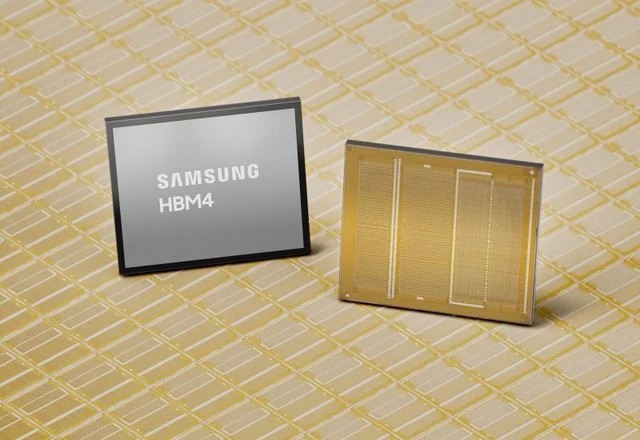
Samsung Electronics has pivoted toward the HBM4 memory market with an unprecedented level of aggression. Having commenced shipments in February of this year, the company has demonstrated a staggering growth trajectory: in just four months, revenue in this segment surpassed the $1 billion mark. This result represents a historic precedent for Samsung, as no other product in the company's portfolio has ever crossed such a financial benchmark so rapidly following the launch of mass production. According to TrendForce analytics, this figure could climb to $1.2 billion by the end of the month, prompting experts to revise annual production forecasts upward from 3.5 to 4 billion gigabits.
Samsung's technological edge in this generation of memory is rooted in the deep integration of cutting-edge fabrication processes. A pivotal advantage lies in the base die, which the company produces using a 4-nanometer process featuring FinFET transistor architecture. When paired with DRAM chips manufactured via the 1c process, the result is a high-efficiency stack capable of meeting the most stringent bandwidth requirements.
Against this backdrop, SK hynix's strategy appears considerably more prudent. While Samsung is striving for maximum market share capture, SK hynix has begun to throttle the pace of its HBM4 supply expansion. The company's technological stack for this generation relies on the 1b process for DRAM chips, while the production of the base die has been outsourced to TSMC, which utilizes a more mature, albeit less dense, 12-nanometer process.
This conservatism from SK hynix is driven by a pragmatic financial calculus. The company is redistributing resources toward the production of standard DDR5 and LPDDR5 memory, where profit margins could reach an impressive 90% over the coming year. Given that HBM across all generations already accounts for approximately 40% of SK hynix's revenue, management has opted to focus on maximizing profitability rather than simply scaling volume. Furthermore, long-term commitments to giants like Microsoft have acted as a significant constraint, forcing the company to slow the retooling of its production lines. Consequently, significant volumes of HBM4 from SK hynix are not expected to hit the market until the third quarter.
The third contender in this triad is the American firm Micron Technology. Micron's strategy is defined by a search for the optimal equilibrium between expenditure and yield; consequently, the company is currently prioritizing the HBM3E segment. For its HBM4 solution, Micron is combining proprietary base die developments with the 1β process for DRAM chip production.
Despite their diverging approaches to expansion, all three manufacturers have already secured crucial validation from Nvidia. However, the outcome of this technological battle will depend on what the market prizes most in the coming years: Samsung's aggressive capacity scaling and technological leap, or the balanced financial models and operational stability offered by SK hynix and Micron.
 The Economic Paradox of the GeForce RTX 5090