The global electronics market is undergoing a fundamental shift in the balance of power. China has evolved beyond its role as a mere supplier of low-cost components, emerging instead as the primary arbiter of pricing for critical technologies. The decision to hike LCD panel prices ahead of the peak season exposes a precarious dependency of global brands on their eastern neighbor. Tech titans like Samsung and LG are now compelled to operate according to rules dictated by their direct competitors.
The television manufacturing industry is facing severe headwinds at the most critical juncture of the annual cycle. BOE, TCL China Star Optoelectronics Technology (TCL CSOT), and HKC Display Technology have officially notified their largest clients of a strategic pivot in pricing. The impact extends beyond the South Korean giants Samsung and LG, hitting the Japanese powerhouse Sony as well. While the rollout varies—TCL CSOT and HKC began implementing new tariffs in September—BOE plans a full transition to updated pricing in the fourth quarter.
For consumer electronics OEMs, the timing could not be more precarious. August and September are the peak months for inventory accumulation and production scaling ahead of global sales events, such as Black Friday and the winter holiday season. Samsung and LG now find themselves in a strategic deadlock: slashing procurement is impossible without sacrificing market share, yet seeking alternative suppliers on such a tight timeline is futile, as viable alternatives have virtually vanished.
Crucially, this price surge is not driven by genuine component shortages or a spike in demand. Industry analysts note that capacity utilization for some Chinese production lines hovers around only 70%. Rather than maximizing output to saturate the market, Chinese players are deliberately restricting supply. This is a classic supply-side management mechanism designed to maintain high price points, signaling a market shift from a phase of competition to one of rigid control.
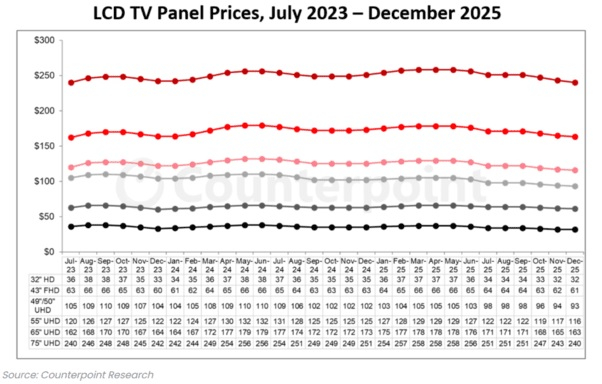
This strategy has been enabled by the emergence of a formidable oligopoly. In the large-format LCD panel segment (65, 75, and 85 inches), the combined market share of BOE, TCL CSOT, and HKC reaches 70–85%. In the ultra-large screen category, Chinese firms have effectively established a total monopoly.
The road to this dominance was paved with aggressive expansion and ruthless price wars. In recent years, leveraging massive capacity expansion and state subsidies, Chinese manufacturers crashed the cost of LCD panels. This transformed the product into a low-margin commodity, rendering production economically unsustainable for the industry's traditional leaders.
Consequently, South Korean and Japanese firms were forced into a painful restructuring process. Samsung Display completely ceased LCD production in 2022, pivoting toward the higher-margin OLED segment. LG Display was similarly compelled to scale back television panel production in South Korea and divest its assets in Guangzhou. Thus, the strategic retreat of Korean companies from traditional LCD technology—which initially appeared to be a transition toward superior standards—was, in reality, a consequence of losing competitiveness against the sheer scale of Chinese industrial power.
 Meta’s New Era of Visual Interaction