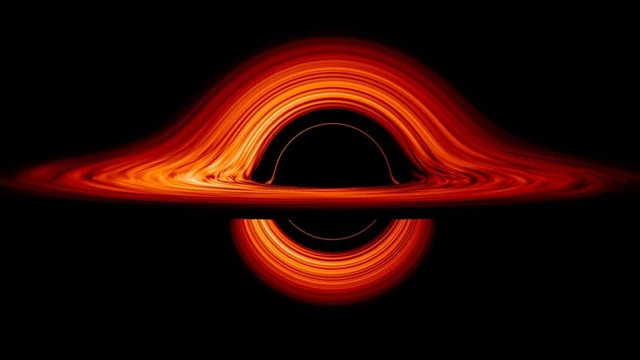
For decades, the event horizon has stood as science's ultimate frontier—the precise point where physical reality converges with pure mathematics. This invisible threshold, beyond which spacetime curves toward infinity, was long regarded as a theoretical construct, accessible only through the lens of indirect computation. Yet, the advent of gravitational-wave astronomy has enabled humanity to transcend these abstractions. The latest data suggest that we have, for the first time, captured tangible evidence from the very precipice of the abyss.
For decades, the event horizon remained a purely theoretical construct. Scientists could only estimate its location based on an object's mass and rotational velocity, but the boundary itself remained a "ghost"—a mathematical line that was impossible to cross, let alone observe. This paradigm shifted with the advent of gravitational wave detectors, which effectively transformed the universe into a colossal acoustic instrument capable of capturing the subtlest vibrations in the fabric of spacetime.
The catalyst for this breakthrough was event GW250114, recorded on January 14, 2025, by the LIGO interferometers in Hanford and Livingston. It stood as one of the most powerful black hole mergers in observational history: two objects, each approximately 30–40 solar masses, collided to form a single, rotating black hole. Such a violent coalescence triggers a colossal release of energy in the form of gravitational waves.
The stabilization process of a newborn black hole is akin to striking a massive bell. The object begins to "ring" at specific frequencies determined by its physical parameters—mass, spin, and, theoretically, electric charge. In physics, this state is described as the regime of quasinormal modes. Until now, these "after-rings" have been the primary focus of study, allowing scientists to verify the general characteristics of black holes.
However, in the case of GW250114, researchers pushed the boundaries of analysis. Beyond the familiar "ring" of quasinormal modes, they detected a more subtle and elusive component: the so-called "direct wave." According to theoretical models, this wave is a direct consequence of the turbulent behavior of matter under conditions of extreme spacetime curvature immediately adjacent to the event horizon.
It is crucial to understand the specificity of analyzing such data. In gravitational-wave astronomy, there are no "snapshots" in the conventional sense. What the instruments register is an intricate noise profile that is impossible to interpret without the aid of supercomputers. Scientists generate thousands of potential scenarios—varying masses, angular velocities, and orbital trajectories—and then seek the most precise correlation between the model and the actual signal received. Thus, the detection of the "direct wave" is the result of a sophisticated mapping of reality against a mathematical archetype.
From a physical standpoint, the direct wave possesses unique characteristics: its frequency is approximately twice the rotational frequency of the black hole. Simultaneously, the signal decays rapidly due to intense gravitational redshift, which literally "stretches" the wave as it attempts to escape the region of super-strong gravity. The fact that this component appeared with high statistical significance in event GW250114 provides strong evidence that we are witnessing a real physical process rather than a modeling error.
If this interpretation is confirmed by subsequent observations, astrophysics will gain a fundamentally new diagnostic tool. We will no longer rely solely on the "echoes" of already formed objects; instead, we will be able to study the physics of processes occurring mere millimeters from the point of no return. A realm that for decades existed only within the theoretical confines of general relativity textbooks is finally becoming an object of direct empirical research.
 Drones for Cloud Cover Management Over Solar Power Plants