The vision of space as an industrial hub is rapidly evolving from the realm of science fiction into the domain of applied economics. Synthesizing materials in microgravity unlocks unique substance properties that remain fundamentally unattainable within the constraints of terrestrial laboratories. Yet, the primary technological bottleneck has consistently been the challenge of ensuring the safe and scalable return of finished products to Earth. The launch of the Starfall capsule represents a strategic pivot toward the establishment of a comprehensive orbital logistics infrastructure.
The ambition of establishing extraterrestrial manufacturing facilities requires more than just a means of orbital delivery; it necessitates a robust mechanism for cargo repatriation. This is precisely the challenge addressed by the new Starfall project, which saw its debut launch aboard the time-tested Falcon 9. Lifting off from Space Launch Complex 40 at Cape Canaveral, the mission served as yet another testament to SpaceX's operational efficiency: nine minutes after launch, the rocket's first stage touched down with surgical precision on the A Shortfall of Gravitas drone ship in the Atlantic Ocean.
The Starfall project is the brainchild of Varda Space, a company that has already carved out a niche in the field of returnable spacecraft. Previously, the firm operated a series of compact, conical W-series capsules. With a diameter of just 0.9 meters and a mass of approximately 300 kg, these vehicles served as technological demonstrators. One such module successfully delivered a payload for the U.S. Air Force after two months in orbit, proving the viability of the concept. However, transitioning from experimental prototypes to industrial-scale operations required a fundamentally different tool.
Starfall represents a quantum leap in both scale and capability. The capsule's diameter has been expanded to 3.1 meters with a height of 0.75 meters, enabling the transport of payloads weighing up to 1,000 kg. This increased volume allows for the delivery of full-scale batches of high-tech materials—ranging from crystallized proteins for pharmaceuticals to specialized optical fibers, whose quality is often compromised on Earth by convection currents induced by gravity.
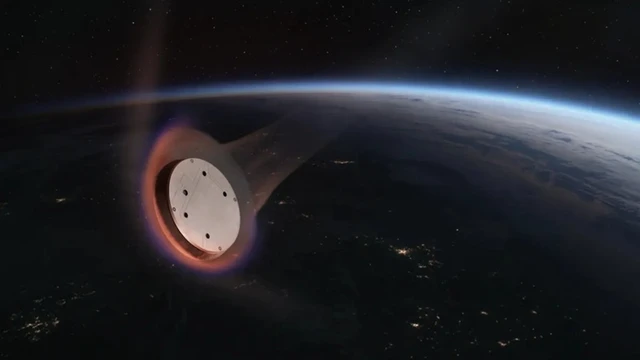
The technical architecture of Starfall is dictated by the rigorous demands of surviving reentry into the dense layers of the atmosphere. The structure is divided into two primary segments: an upper section serving as the cargo hold and housing the attitude control systems, and a lower section consisting of a massive carbon-fiber heat shield designed to withstand the extreme temperatures of the plasma layer.
To ensure a precise entry trajectory and the subsequent jettisoning of the heat shield, the craft utilizes a compressed gas system. This system is responsible for maneuvering in both vacuum and atmospheric conditions—a critical factor for hitting the designated splashdown zone and ensuring the correct deployment of the parachute system.
The mission will culminate in a splashdown in the Pacific Ocean, approximately 1,300 kilometers off the west coast of the United States. While the exact duration of Starfall's orbital stay remains unspecified, the launch of such a scalable vehicle signals the maturation of an infrastructure geared toward regular "space logistics." This transition effectively evolves Low Earth Orbit (LEO) from a site of pure research into a fully realized production facility with a streamlined delivery system for end-consumers.
 Taiwan's Space Program: The First Major Milestone