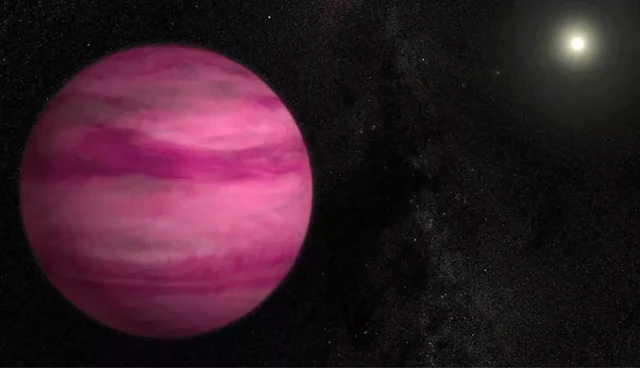
Space frequently defies our conventional understanding of the norm, unveiling celestial bodies that border on the fantastical. Among these enigmas is the exoplanet GJ504b, whose striking pink hue has left astronomers perplexed for decades. It was only through the unprecedented capabilities of the James Webb Space Telescope that scientists were able to pierce the veil of uncertainty and decode the spectral signature of this distant world. The findings reveal that this exotic coloration is the result of a complex interplay between light and salt-laden clouds—a discovery that is compelling researchers to fundamentally re-evaluate the methodologies used to analyze distant planetary systems.
Situated 57 light-years from Earth, GJ504b has been a focal point of astronomical scrutiny since its discovery in 2013. While it orbits a star remarkably similar to our own Sun, the planet itself is an anomaly. For years, its most enduring mystery has been its visual profile: the planet possesses a distinct pink hue that defied explanation via the standard atmospheric models available to ground-based observatories.
Unlocking this mystery required the deployment of next-generation instrumentation. The James Webb Space Telescope, with its unprecedented sensitivity in the infrared spectrum, enabled researchers from Northwestern University to solve a formidable technical challenge: suppressing the blinding glare of the host star to isolate the faint, elusive signal of the planet itself. Just two hours of high-precision observation yielded data that fundamentally reshaped our understanding of GJ504b.
Initial spectroscopic analysis revealed that the chemical composition of the atmosphere is characteristic of typical gas giants, containing water vapor, methane, carbon dioxide, and ammonia. However, this chemical cocktail could not account for the planet's specific pink coloration. This forced scientists to pivot their research; rather than searching for rare chemical elements, they focused on the physics of light transmission through atmospheric layers.
The breakthrough revealed that the key lies in clouds composed of evaporated salt particles. These saline formations act as a colossal filter, scattering and attenuating light emanating from the deeper, hotter layers of the atmosphere. Consequently, the spectral signatures are warped, resulting in the characteristic pink glow observed from afar. This discovery introduces a significant paradigm shift in astronomical methodology: researchers now recognize that cloud structure can mask or entirely distort a planet's chemical signatures, creating the illusion of a different composition.
Beyond its visual peculiarities, GJ504b poses a fundamental inquiry regarding its origins. The object defies conventional classification; with a mass approximately 25 times that of Jupiter, it occupies a liminal space between a massive gas giant and a brown dwarf—a "failed star." In scientific literature, such bodies are referred to as planetary-mass companions.
Exactly how this object formed remains a subject of debate. Two primary hypotheses exist: either GJ504b emerged through the classical route of an accretion disk of matter surrounding a young star, or it formed like a star—via the direct gravitational collapse of a massive gas cloud.
The study was further complicated by the planet's temperature. GJ504b is comparatively cool, with surface temperatures hovering around 288°C, whereas most objects available for direct observation exceed 538°C. This low thermal signature suggests an advanced age, estimated to be between 2.5 and 4 billion years. It was precisely this "coolness" that rendered the planet nearly invisible to ground-based instruments, as it emits significantly less energy.
This breakthrough was made possible by the James Webb Telescope's ability to isolate specific wavelengths from the background noise. By filtering out interference, the telescope transformed a diffuse pink blur into a detailed physical model, opening a new chapter in exoplanetary research where salt clouds are recognized as a factor as critical as the chemical composition of the atmosphere itself.
 Drones for Cloud Cover Management Over Solar Power Plants