The race for quantum supremacy has evolved into one of the most capital-intensive and high-stakes gambles in the history of modern science. While industry titans strive to stabilize existing quantum architectures, Microsoft is wagering on a fundamental breakthrough—one that could either rewrite the laws of physics or prove to be a prohibitively expensive miscalculation. At the heart of this strategic clash are hypothetical particles promised to deliver unprecedented computational stability. Yet, recent publications in Nature have once again cast doubt on the validity of the corporation's claims.
The modern world stands on the precipice of a computational revolution—one capable of rendering current cybersecurity protocols obsolete and solving problems that today seem insurmountable. The scale of ambition is staggering; the U.S. government has already invested approximately $2 billion with the goal of deploying a fully operational quantum system by 2028. While industry titans like Google and IBM are locked in this race, Microsoft is pursuing a strategy fundamentally different from its competitors. Rather than incrementally refining established technologies, the company has spent two decades attempting a quantum leap, bypassing several evolutionary stages by betting on the frontiers of theoretical physics.
At the heart of Microsoft's strategy is a gamble on Majorana fermions—hypothetical particles that act as their own antiparticles. In theory, leveraging these particles would enable the creation of topological qubits, which possess an extraordinary resilience to external interference and decoherence—the primary Achilles' heel of all contemporary quantum computers. The empirical discovery of such fermions would almost certainly guarantee a Nobel Prize in Physics, yet in practice, they remain elusive.
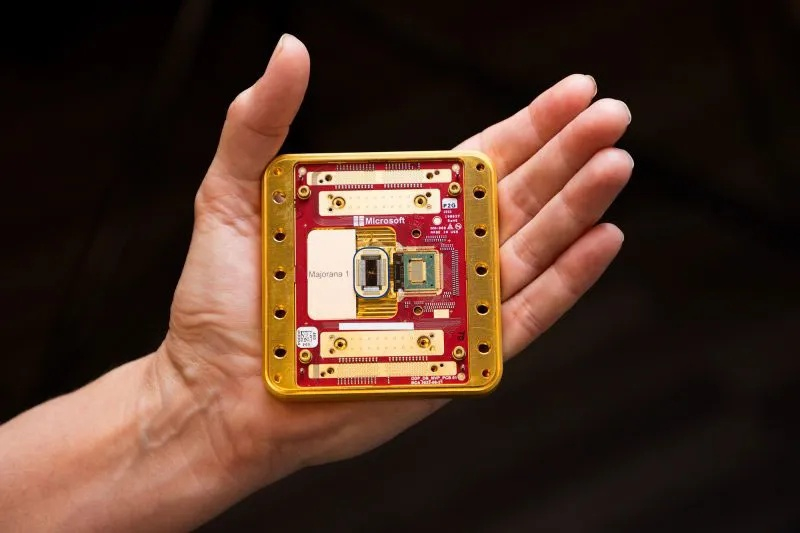
To bridge this gap, scientists are engineering quasiparticles known as "zero-energy modes." These are complex structures of supercooled electrons designed to mimic the properties of Majorana fermions. Their generation relies on topological conductors—materials capable of conducting current exclusively along their surface. The technical implementation within the Majorana 1 processor is based on a modified Josephson junction: a classic architecture consisting of two superconductors separated by an insulator, where one component has been replaced with a topological material.
However, the path toward the ideal qubit has been fraught with difficulty and marred by significant scientific controversy. The physics community views Microsoft's claims with deep skepticism, and for good reason: two of the company's papers previously published in Nature were retracted. The journal's editors cited critical errors in the data, and the corporation later attempted to distance itself from the publications, claiming the research was conducted outside its own laboratories and had not undergone internal review.
A new chapter in this discourse opened with a publication in February 2025. In this latest work, Microsoft shifted its focus from the direct detection of fermions to software designed to identify a "topological gap" within the conductor. The existence of this gap theoretically confirms the possibility of creating long-lived qubits and serves as the bedrock for all of the company's current development.
Nevertheless, independent experts view this as little more than an attempt to mask a lack of empirical evidence. Henry Legg of the University of St Andrews argues that the results were presented in a one-sided manner. According to Legg, a comprehensive analysis of the full dataset published by Microsoft reveals that the claimed "gap" is, in reality, nothing more than random stochastic noise. This revelation undermines the entire evidentiary basis upon which Microsoft's promise to deliver a working system by 2029 is built.
This skepticism is echoed by Sergey Frolov, a physicist at the University of Pittsburgh. He emphasizes that the industry has yet to see a series of reliable, reproducible experiments that could validate Microsoft's claims. Instead of a fundamental scientific foundation, there is only a trail of contentious papers that are being challenged by peers at the most basic level.
In response to the criticism, Microsoft is pivoting from the language of theoretical physics to that of engineering pragmatism. Chetan Nayak, who oversees quantum hardware development, asserts that their software is less a tool for scientific discovery and more a "practical tuning tool" for the chips. In Nayak's view, debates over the theoretical purity of the method are irrelevant if the device actually functions and executes operations. His position is starkly simple: while the critics are debating the physics of flight, Microsoft is simply inviting them to board the plane and fly.

 Drones for Cloud Cover Management Over Solar Power Plants