For years, one of the most enduring enigmas of the early universe has been the existence of gargantuan objects that seemingly defied the constraints of cosmic time—structures far too massive to have grown to such scales within the available window. Supermassive black holes, with masses billions of times that of our Sun, appeared in the cosmos far earlier than traditional evolutionary models predicted. The primary obstacle to their growth was long thought to be a "self-starvation" paradox, where intense energy emissions would repel the very matter needed for accretion. However, recent data from the James Webb Space Telescope are prompting a fundamental reassessment of this process, revealing a hidden mechanism of cosmic recirculation.
At the heart of nearly every massive galaxy lies a supermassive black hole. In most instances, these entities remain "dormant giants," consuming surrounding gas and dust at an almost imperceptible rate. However, there are Active Galactic Nuclei (AGN)—objects with an insatiable appetite that transform the centers of their systems into blinding cosmic beacons. This activity comes at a steep price: by ejecting streams of matter from their poles in the form of powerful jets, the black hole effectively clears out the raw materials necessary for star formation, thereby depriving itself of long-term sustenance.
This mechanism presents a fundamental paradox for astrophysicists. According to standard calculations, the process of accreting matter and subsequent black hole mergers should take at least a billion years for an object to achieve supermassive status. Yet, observations reveal that such giants existed in the very early universe. The situation is further complicated by the fact that the most voracious objects grow the fastest, but simultaneously repel gas most efficiently, creating a state of forced starvation.
The resolution to this paradox may lie in the concept of a self-regulating "feast and famine" cycle. This hypothesis suggests that the matter expelled by a black hole does not vanish forever. Over time, the gas cools and, driven by gravity, rains back down toward the galactic center. This process occurs not uniformly, but through the formation of slender gaseous filaments or "streams"—hundreds of light-years wide and stretching across thousands of light-years. Upon returning to the center, this gas forms a rotating accretion disk, triggering a new cycle of rapid growth and subsequent energy discharge.
For a long time, this theory remained an elegant model, as the link between these gaseous filaments and galactic centers was extremely difficult to capture instrumentally. This changed with the deployment of the James Webb Space Telescope (JWST), which enabled a detailed study of the active nucleus of galaxy NGC 4696 in the Centaurus cluster, located 145 million light-years from Earth.
Previously, the Hubble Space Telescope had detected a strange, hook-shaped vortex of gas in this region. However, only Webb's spectroscopic capabilities and superior resolution allowed for an accurate mapping of these flows. The study revealed that the hook-like structure is approximately 800 light-years wide, with gas moving within it at a staggering velocity of roughly 600 km/s.
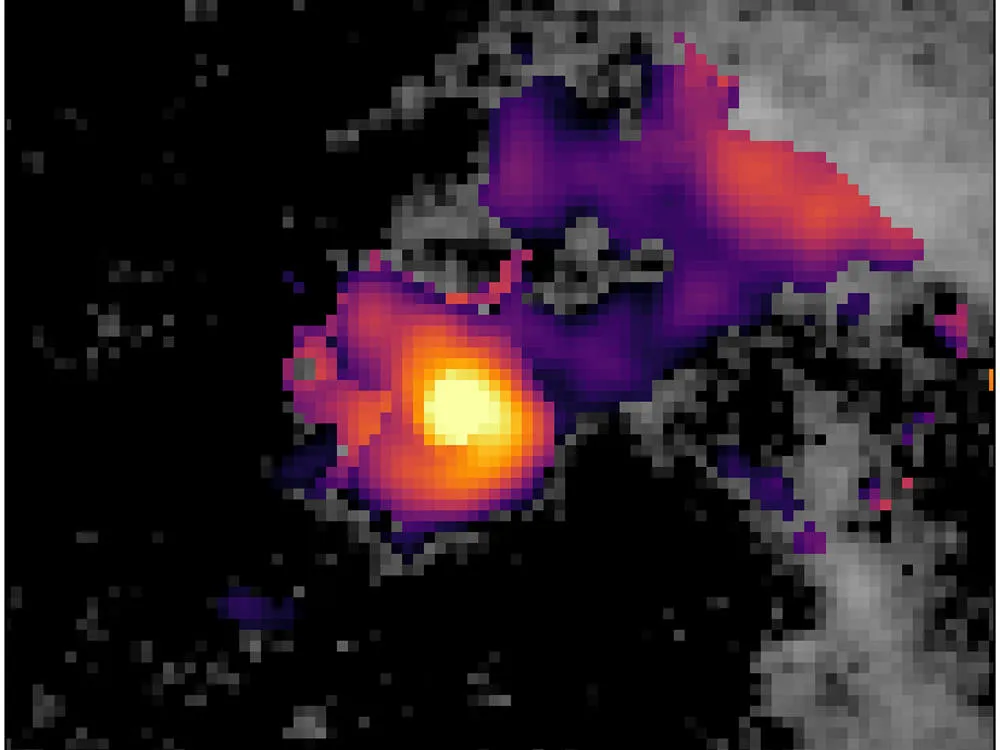
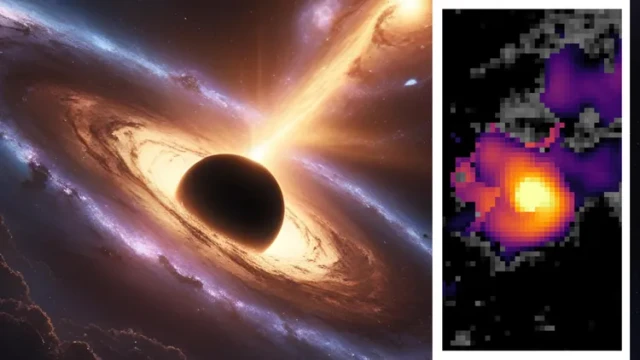
The pivotal discovery was that this vortex is directly linked to a massive filament of matter that is literally "draining" into the central black hole. Comparing these data with computer simulations confirmed that the scenario of infalling filamentary structures perfectly matches the observed morphology of NGC 4696.
In doing so, astronomers have uncovered the final missing link in the chain of cosmic metabolism. Black holes function as global matter recyclers: they heat the surrounding space, triggering the expulsion of gas, which then cools and returns to feed the gravitational monster once more. This closed-loop cycle explains how supermassive objects were able to overcome the temporal constraints of the early universe to reach their incredible scales.
 BepiColombo’s Odyssey: At the Threshold of the Sun