The search for dark matter remains one of the most formidable frontiers in modern fundamental physics. In the absence of direct empirical evidence, researchers are compelled to scour the vast datasets of the world's largest experiments for indirect signatures of this elusive substance. A recent analysis of anomalies within the Large Hadron Collider’s operations has revealed an unexpected avenue toward deciphering the nature of dark matter: a hypothesis suggesting that sporadic system glitches may actually be the result of Earth interacting with massive particles originating from the early universe.
The quest for dark matter is frequently compared to the classic analogy of searching for lost keys beneath a streetlight: researchers tend to look where the light is brightest and most convenient—namely, within the structured databases of high-precision instrumentation. One such instrument is the Large Hadron Collider (LHC), which, beyond its primary mission of studying elementary particles, effectively functions as a gargantuan detector for cosmic anomalies.
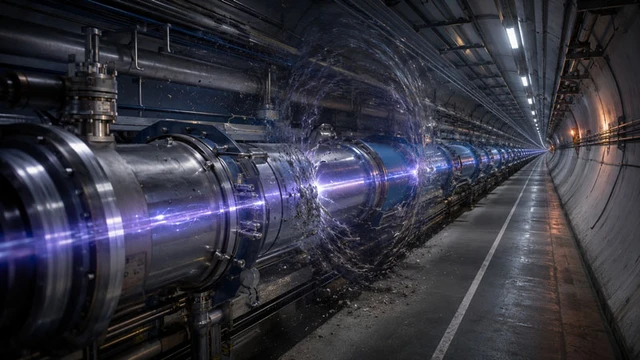
In the operational lexicon of the LHC, there exists a peculiar term: UFOs, or Unidentified Falling Objects. In this context, the term refers not to extraterrestrial craft, but to microscopic dust particles that periodically appear within the deep vacuum of the accelerator tube. These events are problematic because even a single speck of dust can trigger the collapse of a proton beam, an event captured by the system's monitoring sensors. The mystery lies in the energy source: what "shakes" this dust loose from the walls of the vacuum chamber? Spontaneous detachment should not occur under normal conditions.
Physicists from the University of British Columbia have proposed a compelling explanation for this phenomenon. The researchers hypothesized that these mechanical vibrations could be caused by Axion Quark Nuggets (AQN)—a hypothetical form of dark matter born in the immediate aftermath of the Big Bang.
Initially, it was posited that the dust particles themselves were AQN clumps. However, calculations revealed a stark discrepancy: while the particles in the collider are measured in microns, the mass of a typical axion quark matter clump should be significantly higher—ranging from 100 grams to one kilogram. This led the scientists to a new conclusion: the AQNs themselves do not enter the tube; rather, their passage through the Earth's crust generates a powerful acoustic effect.
The interaction mechanism is as follows: a massive clump of dark matter traverses the Earth, passing within 100 kilometers of the collider ring. This movement generates an underground shockwave that propagates through the bedrock to the LHC equipment. The energy of this wave is sufficient to induce micro-vibrations in the accelerator walls, causing dust to detach from the surface and intersect the path of the proton beam.
Validating this theory requires a specific signal pattern. A single instance of beam loss could be an anomaly, but a sequence of three or more events across different sections of the 27-kilometer ring points toward a systemic process. Since the shockwave travels through rock at approximately 4 km/s, related events should occur at intervals ranging from 6 milliseconds to 2 seconds.
Theoretically, such signals could be captured by approximately 4,000 beam loss monitors distributed along the collider's trajectory. To verify the data, the researchers propose cross-referencing these findings with readings from CERN's seismic network, infrasound stations, and distributed acoustic sensors.
Preliminary estimates suggest that AQN interactions could account for between 1% and 10% of all observed UFOs. Mathematical models indicate that over 360 hours of operation, such a series of events would produce a signal five times higher than the background noise level. Currently, this work remains theoretical, providing a methodological blueprint for further research. Confirming the hypothesis will require a deep retrospective analysis of LHC archival data to identify spatio-temporal correlations that cannot be explained by routine mechanical interference or hardware degradation.
 The Era of Seven Hundred Falcon Family Launches