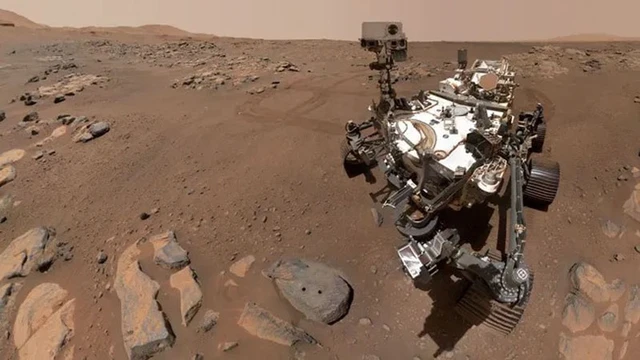
The quest for extraterrestrial life remains one of the most ambitious frontiers of modern science. The Perseverance rover’s mission in Jezero Crater stands as the culmination of decades of research dedicated to the pursuit of biosignatures. Latest data confirms the presence of complex organic carbon compounds embedded within the Red Planet's ancient rock formations—a discovery that necessitates a fundamental reappraisal of Mars' historical habitability and its geological evolution.
The selection of Jezero Crater as the landing site for Perseverance was far from arbitrary. From a planetary science perspective, the location represented an ideal natural archive: billions of years ago, it housed a lake fed by a river that deposited layers of sedimentary rock. It is precisely within these silty deposits on the beds of ancient water bodies that organic signatures of microbial life are most likely to have been preserved, shielded from the planet's aggressive external environment.
A year after the initial promising signals, a more rigorous and deeper analysis of the samples confirmed the presence of hundreds of complex, carbon-based organic molecules within the Martian rock. These findings reignite the hypothesis that the Red Planet's ancient climate was far more similar to Earth's, creating conditions where the emergence of life was not merely possible, but probable.
The linchpin of this discovery was SHERLOC—a sophisticated spectrometer mounted on the rover's robotic arm. The instrument employs Raman and luminescence spectroscopy, allowing for the high-precision determination of mineral composition and the in-situ identification of organic compounds directly on the rock surface. During the study, researchers analyzed samples of mudstones—fossilized silty deposits that naturally serve as exceptional traps for organic matter.
The spectra of these rocks revealed what is known as macromolecular carbon. These are large, complex structures similar to those found in ancient terrestrial rocks and meteorites. Notably, the chemical context of these finds varies: in one sample, the organics are closely associated with silicates, while in another, they coexist with carbonates and sulfates. The latter formed during subsequent cycles of water-rock interaction, pointing to a complex, multi-stage hydrological history for the region.
The degree of preservation of these compounds is particularly striking. The fact that these organic molecules were not entirely degraded suggests they remained beneath the planet's surface for an extended period. This shielded them from harsh solar radiation and the oxidative Martian environment, both of which typically destroy complex carbon chains on the surface. Furthermore, the discovery of similar structures beyond Jezero Crater expands the boundaries of potentially habitable zones, hinting that life may not have been confined to isolated lakes but could have existed on a much broader scale.
Nevertheless, scientific rigor demands caution. The presence of complex organics is not definitive proof of life. Macromolecular carbon can have an abiotic origin; it may have resulted from hydrothermal reactions, chemical synthesis deep within the crust, or been delivered to the planet via meteorites.
Only a detailed laboratory analysis on Earth can resolve this debate. Perseverance was originally designed as a "scout," tasked with selecting the most promising samples for subsequent return. However, the current status of NASA's Mars Sample Return (MSR) program remains uncertain, and the mission has effectively been delayed. Consequently, humanity finds itself in a paradoxical position: we have found the key to the cosmos' greatest mystery, yet we are temporarily unable to unlock the door.
 The Evolution of Solid-State Batteries: From Smartphones to Electric Vehicles