For decades, black holes were perceived as absolute cosmic sinks—one-way conduits from which nothing ever returned. This paradigm of total absorption shaped our fundamental understanding of galactic evolution and the behavior of matter under extreme conditions. However, recent astrophysical data are compelling us to rethink the concept of the "insatiable void." It appears these celestial objects do not merely consume; they actively expel matter back into space, functioning less as simple predators and more as sophisticated regulatory mechanisms.
For years, the scientific discourse was dominated by the conception of the black hole as an absolute gravitational trap—an entity that consumes everything in its path without remnant. However, reality is proving to be far more nuanced. Modern observations reveal that the feeding process of these objects is accompanied by powerful matter-rejection mechanisms that effectively throttle the efficiency of their own "appetite."
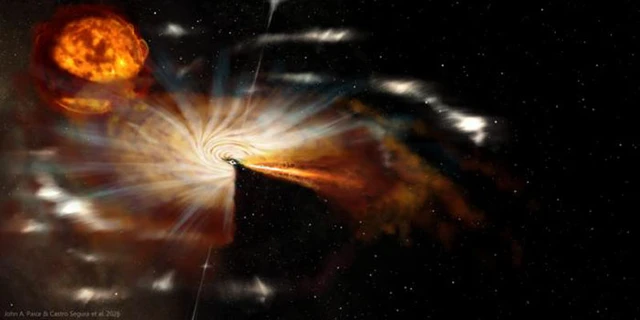
The key to this new understanding was provided by Swift J1727.8−1613, a binary system that exhibited a sharp X-ray outburst in 2023. In this pairing, a black hole interacts with a neighboring star, essentially siphoning off its gaseous envelope. This results in the formation of an accretion disk around the compact object—a vortex of superheated matter that accelerates to colossal speeds and temperatures before finally crossing the event horizon.
To analyze this process in detail, researchers utilized the European Southern Observatory's Very Large Telescope (VLT), equipped with the X-Shooter spectrograph. The instrument's high precision allowed scientists to capture more than just a static snapshot of the catastrophe; they were able to track the dynamics of the system as it evolved. It became evident that the absorption of gas is accompanied by a simultaneous ejection of matter. This process manifests through two distinct mechanisms: highly collimated relativistic jets and more diffuse, yet large-scale flows known as stellar winds.
The most intriguing aspect of the study was the system's behavior during its decay phase. Even when the intensity of the outburst plummeted to one percent of its peak, the ejection mechanisms did not cease. Despite minimal accretion disk activity, dense streams of matter continued to exit the system. This suggests that the dynamics of matter ejection are not merely a byproduct of extreme feeding, but rather a fundamental characteristic of how a black hole interacts with its environment.
From an astrophysical perspective, this discovery is critical. If a black hole can expel nearly as much matter as it consumes, its actual growth rate is significantly lower than theoretically predicted. Furthermore, these "winds" exert a powerful influence on the surrounding interstellar medium, displacing gas and potentially altering star formation processes across entire galactic sectors. Consequently, black holes are no longer viewed as passive consumers, but as active architects of cosmic space, regulating the distribution of matter throughout the universe.
 The Energy Efficiency Ceiling of Modern Electric Vehicles