Humanity's global energy transition is confronting a fundamental limitation inherent in traditional lithium-ion systems. Liquid electrolytes, which long fueled the industry's progress, have now become a critical bottleneck, hindering advancements in both safety and energy density. All-solid-state batteries (ASSBs) are finally emerging from the sterile confines of the laboratory, moving toward real-world road testing and industrial scaling. This shift marks the dawn of a new era for autonomous transportation and mobile electronics.
The energy storage industry is currently navigating a pivotal transition. While the last few decades of battery development focused on optimizing liquid electrolytes, the strategic center of gravity has shifted toward All-Solid-State Batteries (ASSB). By 2026, this technology has cleared one of its most formidable hurdles: the leap from theoretical proof-of-concept to real-world operational validation.
Within engineering circles, this evolution is measured by Technology Readiness Levels (TRL). For years, ASSB development languished in the TRL 1–3 range, existing primarily as chemical formulas and laboratory prototypes. Today, however, the industry's leading players have approached TRL 5–6. This represents a paradigm shift; the challenge is no longer about discovering the right chemical composition, but about optimizing production cycles, stabilizing the performance of mass-produced cells, and tailoring the product to the rigorous demands of the automotive sector.
Currently, Japanese and South Korean conglomerates maintain a strategic lead. Toyota, Honda, Nissan, and Samsung SDI have effectively formed the vanguard, launching small-scale production to conduct deep-dive testing within actual electric vehicles. Nissan’s progress is particularly noteworthy: their trials of cells featuring a 23-layer stacked architecture have demonstrated significantly higher capacity stability compared to traditional lithium-ion counterparts. Simultaneously, Chinese giants such as CATL, BYD, and FAW are aggressively scaling their own pilot lines, steadily closing the gap and approaching TRL 4–5.
However, the potential of solid-state batteries extends far beyond the automotive market. Driven by exceptional energy density and enhanced safety—specifically the elimination of electrolyte leakage and combustion risks—ASSBs are becoming the foundational element for next-generation transport and machinery. High-priority applications include autonomous drones, electric Vertical Take-Off and Landing (eVTOL) aircraft, advanced robotics, and specialized construction equipment. Companies such as Maxell, Ilika, ProLogium, and Factorial are already moving beyond conceptual roadmaps toward concrete commercial contracts in these niches.
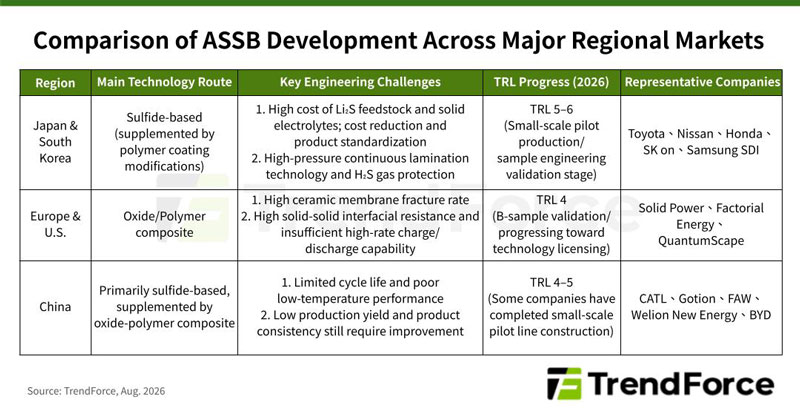
Such a technological leap is contingent upon a robust raw material supply chain. Sulfide-based solid electrolytes have emerged as the dominant chemistry, triggering a surge in demand for lithium sulfide ($\text{Li}_2\text{S}$). Where this material was once supplied in kilograms, production volumes surpassed 600 tons by mid-2026, with projections suggesting an increase to several thousand tons annually by 2027.
The economics of the material are also signaling maturity: over the past six months, the cost of lithium sulfide has plummeted by more than 50%, reaching approximately $219 per kilogram. Although current demand is limited by the scale of pilot production, the industry is at a tipping point. The successful validation of full-scale automotive batteries could trigger an exponential surge in raw material demand, finally transitioning solid-state batteries from a promising innovation to a mass-market industrial standard.
 Driver Attention Monitoring in Tesla Electric Vehicles