In an era of visual saturation within the gaming industry, standard RGB lighting no longer captivates the discerning enthusiast. The premium segment is pivoting away from a raw arms race of performance, moving instead toward the creation of bespoke technological artifacts. The debut of the Cherry Bloom system signals a shift toward the concept of "living" hardware—a paradigm where material physics supersedes traditional electronics. This system transforms thermal output from a mere engineering hurdle into a medium for artistic expression.
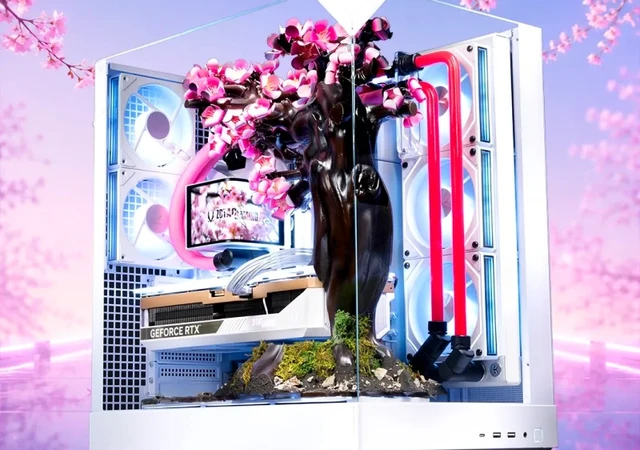
Thermal management in high-performance computing has long been viewed as a pragmatic hurdle for system integrators. However, the Australian firm Aftershock PC has introduced a paradigm shift, transforming thermal energy into a catalyst for visual spectacle. The centerpiece here is not raw computing power, but a bespoke botanical sculpture of cherry blossoms integrated directly into the chassis. Seventy meticulously crafted blossoms, forged from a specialized titanium alloy, are thermo-sensitive: they bloom naturally as the system's components reach operating temperatures.
The engineering sophistication of this solution lies in the total absence of mechanical actuators, servomotors, or software-driven motion control. Instead, the system leverages shape-memory alloys that react to temperature fluctuations, effectively turning the PC into a kinetic installation. This eliminates the risk of mechanical failure and ensures that the "blooming" process is an organic byproduct of the system load.
The visual experience is driven by the components generating the necessary heat flux. At the core of the build is an AMD Ryzen 7 9800X3D processor, paired with 64GB of high-speed DDR5 memory and a GeForce RTX 5080 GPU. Power is delivered by a 1300W modular PSU, while data storage is handled by a 2TB Lexar NQ790 PCIe 4.0 SSD. To maintain the delicate balance between aesthetics and functionality, the system employs a custom open-loop liquid cooling setup and an array of eight Aftershock Chrome RGB fans.
The visual impact is further amplified by the choice of the V2 chassis from Taiwanese brand APNX. Its triple-pane glass architecture creates a panoramic vitrine, transforming the interior of the PC into a technological terrarium. This unobstructed view allows the observer to witness the dynamic unfolding of the petals in detail, turning a standard gaming session into a meditative experience.
Priced at $14,150, the device raises certain questions from the perspective of hardware pragmatism. At this price point, the market offers flagship configurations featuring the Ryzen 9 9950X3D and GeForce RTX 5090. However, the "Cherry Bloom" is a product where utility takes a backseat to concept. The buyer is not merely acquiring a tool for rendering or gaming, but a bespoke piece of industrial art.
Developed in collaboration with Zotac Gaming, the project is less a mass-market product and more an audacious marketing exercise. It signals a new trajectory for the industry, where the computer ceases to be a closed "black box" and instead becomes an element of interior design capable of interacting with its environment on a tangible, physical level.
 Micro-scale Organic Light-Emitting Diodes