The global climate crisis demands a shift from theoretical decarbonization frameworks toward the deployment of tangible industrial infrastructure. Carbon Capture and Storage (CCS) is emerging as a pivotal instrument in the pursuit of climate neutrality, effectively sequestering harmful emissions into inert geological formations. The launch of the Greensand Future project in Denmark marks a critical inflection point, moving beyond localized experimentation toward a comprehensive industrial lifecycle. This initiative establishes the European Union's first scalable standard for the transport and permanent sequestration of CO2.
September 2026 marked a pivotal shift in Europe's environmental agenda: the official launch of the first industrial-scale system in Esbjerg, Denmark, integrating the entire carbon dioxide lifecycle—from capture to final sequestration. The Greensand Future project, executed by a consortium comprising INEOS Energy, Harbour Energy, and the state-owned Nordsøfonden, with €41 million in EU funding, represents a sophisticated engineering feat designed to radically redefine the paradigm of emissions management.
In its initial phase, the system is engineered to process 400,000 tonnes of $\text{CO}_2$ annually, which is projected to sequester approximately 2.4 million tonnes over an eight-year horizon. However, the project's true value lies not in these immediate figures, but in the establishment of a seamless logistical chain. The process begins with the capture of carbon dioxide generated during biomethane production in Denmark and other EU member states. The gas is then liquefied and transported to a specialized terminal at the Port of Esbjerg for temporary storage in dedicated reservoirs.
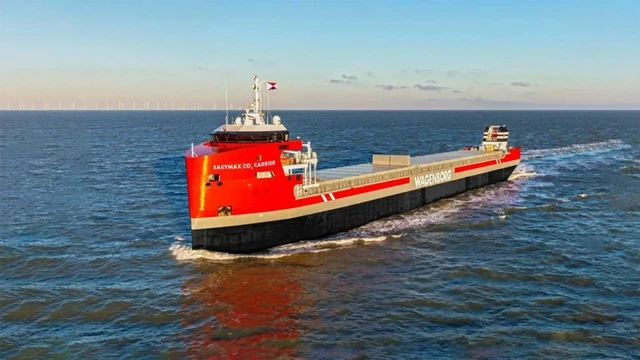
The linchpin of this operation is the Carbon Destroyer 1, a vessel commissioned in May 2025. It is the world's first specialized tanker equipped with state-of-the-art cryogenic and pressure-regulation systems, enabling the transport of liquefied $\text{CO}_2$ over significant distances. The vessel carries the cargo 250 kilometers into the North Sea to the Nini platform.
The final stage of the process involves injecting the gas approximately 1,800 meters below the seabed. The storage site is the Nini West depleted oil field. This location was selected based on its specific geological properties: having trapped hydrocarbons for millions of years, the structure serves as a natural, impermeable reservoir, making it ideal for the long-term, secure sequestration of carbon dioxide.
It is essential to recognize that Greensand Future is an evolution of a successful 2023 pilot project, which proved the viability of cross-border $\text{CO}_2$ transport within the EU. The technology has now transitioned from a proof-of-concept to a fully realized industrial standard.
In the long term, the consortium plans to scale the system's capacity exponentially, targeting 4–8 million tonnes of $\text{CO}_2$ per year. To achieve this, the foundation for expanding both onshore and offshore infrastructure is already being laid. The consortium's primary achievement is the creation of a comprehensive technological stack: from gas separation and liquefaction to maritime logistics and deep geological sequestration. This scalable model is intended to serve as the blueprint for a pan-European carbon footprint management network, transforming fragmented local initiatives into a unified system of environmental security.
 The Technological Leap of China's Consumer Market